
I just got back from one of my favorite events: The annual Creativity Conference at Sea Island, GA. There, famous entomologist Mark Moffett brings together an eclectic group of scientists, artists, naturalists, musicians, writers, and more, for two days of talks on topics of wide-flung interest. My husband and I have attended this conference for the past five years; we plan our January around it. We have met magicians, Nobel laureates, lemur experts, famous authors, Match.com’s algorithm designer, and more. I’m always enthralled by the sharp minds and latest ideas.
This year I met Dr. Bonnie Bassler, Chair of the Department of Molecular Biology at Princeton. She’s a powerhouse of a researcher, a MacArthur fellow, a member of the US Academy of Sciences, and a recipient of numerous awards. She’s also really excited about her research and a dynamic and enthusiastic speaker. She gave a riveting talk, and later, I was lucky enough to sit with her at dinner. We yakked about germs the whole time. Bonnie’s lab has spent years working on the question of communication among bacteria.
Think about this. Bacteria are small, and our bodies contain trillions of them. Of the ones that are pathogenic, and can make us sick, how do they accomplish that? If a single bacterium which makes a toxin fired off its dangerous toxin inside us, it would make no difference, because it is such a miniscule amount. But if that little bacterium sat and waited until it and its friends multiplied into a crowd, and then released their toxins, we would feel the effects.
How do they know to wait? How do they know when they have become a crowd? Are they planning ahead? I’m anthropomorphizing this a bit, but it’s the easiest way to think about it. It’s either your worst nightmare or incredibly exciting. For Bonnie Bassler, it is exciting, and it is the question she and her research team have worked on for years.
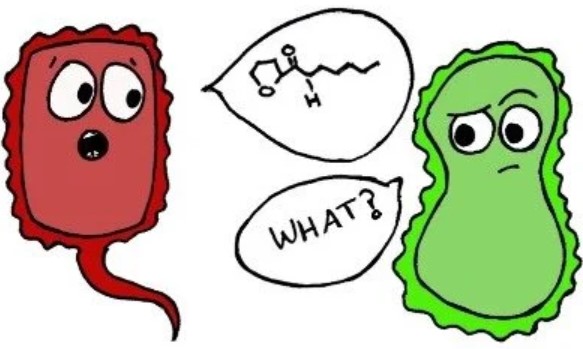
In the 1990s, Michael Silverman discovered “quorum sensing” (sensing how many there are) in the marine bacterium Vibrio fischeri. This is a bioluminescent bacterium, but it only glows its green light when it senses there is a large enough number to make a light source. How does it know? Bonnie Bassler did her postdoctoral work with Silverman. Their research showed that these bacteria release specific molecules, chemical signals saying “I am here” to other bacteria. When the bacteria sense enough of these “I am here” molecules, they know they are in a crowd. And then, when they can have an impact, they take action.
(As an aside, these Vibrio fischeri are famous because they colonize the light organ in the Bobtail Squid, a small nocturnal squid that lives in shallow coastal waters. The bioluminescent glow from its light eliminates the squid’s shadow and masks its silhouette, like an invisibility cloak. Thus, the squid can hide from predators as well as its prey. Want to know more? Read this. https://news.ucsc.edu/2021/03/bioluminescent-squid/ )
Bonnie’s team has proven that bacteria have multiple chemical signals for communication with each other. They can sense self and other, meaning they can tell if they are in a crowd of the same kind of bacteria, or in a crowd of strangers. And they modify their behavior based on this.
Bonnie’s work is ongoing, and she has found that other organisms, including human cells and viruses also have quorum sensing conversations. This has amazing implications! Think about it! What if the cells in your gut sense a growing crowd of worrisome bacteria, like Clostridium difficile (which can cause terrible diarrhea). Can your gut cells signal white cells to come to the defense? Perhaps the myriad bacteria in our gut microbiome send out different messages to rebalance bacteria populations. So many possibilities! So many questions to try to answer!
Maybe there are fake signals. It is entirely possible that cells can send out chemical signals to bacteria, to confuse them, to block their quorum sensing, so the bacteria don’t realize they are a crowd. (Wave of hand, “These are not the droids you are looking for.”)
This also has therapeutic implications. Bonnie’s lab is doing fascinating work on quorum-sensing-blockers, chemicals to prevent harmful bacteria from communicating with each other. They have created decoy chemicals that block the quorum-sensing process, chemicals that transmit a message of “Do nothing, there are not many of us around.” This could prevent pathogenic bacteria from working together, without harming beneficial bystander bacteria.
Here’s a fascinating example. The pathogenic bacteria Pseudomonas aeruginosa is a particularly bad actor. It’s good at becoming antibiotic resistant, infecting immunocompromised people, and creating biofilms. Biofilms are slimy communities of bacteria living in a complex matrix that easily adheres to surfaces and is difficult to eradicate. Bonnie’s lab has created quorum-sensing-blocking chemicals that can prevent P. aeruginosa from secreting toxins and making biofilms! Her lab is working on ways to permeate medical equipment (like catheters and IV tubing, where P. aeruginosa like to create biofilms) with quorum-sensing-blockers. There’s still a lot of research to be done before this becomes safe for use in humans, but the possibilities are exciting!
Bonnie has been working on these questions for 30 years. And she says (in a Howard Hughes Medical Institute article), “I thought I’d figure all this out during my career. I thought I would solve this, and I’m not even close. And so, on the one hand, that’s sort of, sad for me, right? Because I won’t be around long enough to figure out all I want to know about quorum sensing. But on the other hand, that’s so exciting because it means we’re working on something that’s worthy of our time and effort…. That’s the greatest kind of career one could have – where you’re still running as fast and as hard as you can, and not getting to the finish line.”
Want to know more? Look at these.
TED Talk https://www.ted.com/talks/bonnie_bassler_how_bacteria_talk
TED Talk https://www.youtube.com/watch?v=q2nWNZ-gixI
Mark Moffett https://www.doctorbugs.com/
“That’s the greatest kind of career one could have – where you’re still running as fast and as hard as you can, and not getting to the finish line.” Difficult, yet exciting at the same time. Hopefully others will continue with her work when she moves on.
We should all hope for this kind of career!