
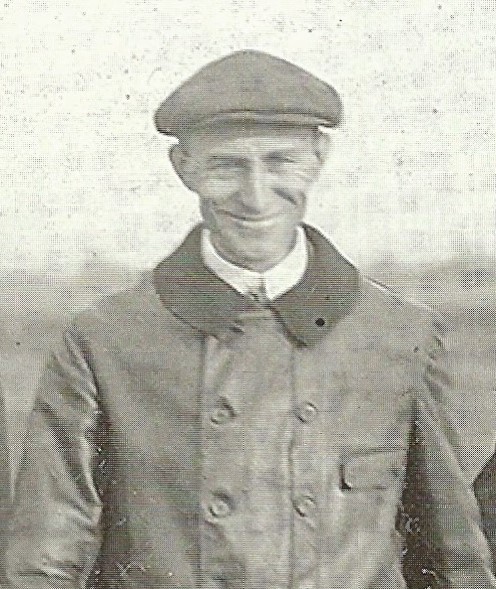
Winter, 1885, on an icy pond in Ohio, in the middle of a hockey game, Oliver, a 15-year-old neighborhood bully, whacked 17-year-old Wilbur in the face with his hockey stick. Nobody is sure if it was an accident or on purpose. (Wilbur’s dad’s diary says, Oliver “threw the bat that struck Wilbur”.) Wilbur lost several of his upper teeth and had a broken jaw. A couple of the dads watching the game were Army doctors and offered to tend to Wilbur and carry him home. He declined, saying it would scare his mother if he were carried home. So, he walked.
It was a terrible injury for young Wilbur. He was studious, taking the typical Greek, Latin, and math in his senior year of high school, intent on going to Yale and then into the ministry. But everything changed. He was home for months, suffering terrible pain in his face and jaw. He required extensive surgery. He had trouble eating, subsisting on eggs and milk and occasional toast. He lost weight and developed digestive problems. He grew depressed and withdrawn. He developed heart palpitations and seemed to redefine himself as a semi-invalid. It was a long time before he could be fitted for false teeth. He grew sensitive about his appearance. No more plans for Yale; no more college plans at all. His entire family was worried about him. His mother, quite ill with tuberculosis, was home-bound, and tending to her became his job. His older brothers described him as a recluse, as “cook and chambermaid”. For the next three years, he rarely went out.
His three older brothers went on with their lives. The two oldest married, held down jobs, had children. His closest brother finished school, designed a printing press, and grew successful printing a local newspaper. Wilbur, sequestered at home with his lack of teeth and his depression, took to reading. His family was an intellectual one, with two libraries in their house: one for his father’s religious texts, and another for two full sets of encyclopedias, histories of England and France, popular writers like Sir Walter Scott, books on science like those of Charles Darwin, books on mechanics and engines. It was three years later, after his mother died, that he finally began to look outward. He went to work with his brother at the printing shop. But he was never interested in college again, and so his life path took a different course.
By 1893 Wilbur and his brother were caught up in the newest tech craze: bicycles. They had a successful bicycle design and repair shop. Wilbur wrote that he and his brother were exceedingly close. “From the time we were little children, my brother …. and myself lived together, played together, worked together, and, in fact, thought together. We usually owned all of our toys in common, talked over our thoughts and aspirations so that nearly everything that was done in our lives has been the result of conversations, suggestions, and discussions between us.” And by 1896 they were intently studying glider designs and learning everything they could about flight. And, as you know, the rest is history. By 1903, on that windy day at Kitty Hawk, NC, the Wright Brothers made the first official powered flight.
They became immediately world-famous. Wilbur was known to be quiet and reticent. He avoided speaking engagements as much as possible. All the photos I could find of him are either solemn looking or with a closed-lipped smile. I suspect he was still sensitive about his teeth. Dentures of that time were typically vulcanized rubber (invented by Goodyear!) with porcelain teeth, and notoriously uncomfortable and ill-fitting. Current studies show, even with the dental technology we have now, that over 50% of denture wearers are unhappy with their looks, and one-third of them admit to being nervous or unsure because of their teeth.
And what of Oliver Haugh, the kid who whacked Wilbur in that fateful ice hockey game? He was as big as a man by the time he was 15 and already had a reputation as a bully. He was known to pick fights. Oliver had a dental problem of a different kind, a mouthful of painful, rotten teeth. He worked for the local druggist, who took pity on him and gave him the popular “Cocaine Toothache Drops”. He quickly graduated to “Bateman’s Pectoral Drops” which contained opium. Thus began a life-long drug habit which he never really escaped. He enrolled in Cincinnati Medical College, but the combination of his drug and alcohol problems and financial trouble led to poor attendance. He fell in love, and after the sudden death of his fiancée’s father, they married. Her inheritance allowed him to return to medical school, but he was asked to leave after one semester. He did finally graduate from Louisville Medical College in 1893 and opened his own medical practice in Dayton.
This is where his story takes a turn. He became obsessed with Robert Louis Stevenson’s 1886 book Strange Case of Dr. Jekyll and Mr. Hyde. Oliver developed a fixed belief that two beings could share a single body, and set about to use himself to prove it. He was sure he could develop a drug to usher in a new era of science and create a new race of super beings.
For the next 10 years, Oliver’s life was a roller coaster of ups and downs, one ”unfortunate” event after another. He had several affairs, and several marriages while still married to previous wives. He opened and closed one medical practice after another, moving to a new town each time. He was arrested a few times after suspicious patient deaths. He was admitted to an asylum a couple of times. On more than one occasion, there was a sudden death (of a new wife or in-law), and Oliver was able to use an inheritance to open his next medical practice. He was arrested for disorderly conduct. His life in a downward spiral, he eventually returned to Dayton and moved in with his family. His original wife refused to have anything to do with him and filed for divorce. His parents cut him out of their will. Then, mysteriously, his parents’ house caught on fire and only Oliver escaped. His parents and his brother died, trapped inside.
Oliver didn’t cover his tracks very well. He had ordered a large amount of highly flammable oil just before the fire. He had also rush-ordered a bulk order of hyoscine hydrobromide. You know it as Scopolamine and have probably used it in a patch for seasickness. In high doses, it can cause severe drowsiness, unconsciousness, seizures, and respiratory difficulty.
Oliver was arrested and tried for arson and murder. By the end of the investigation, it was believed that he had been married 9 times, and 4 of his wives had died from spinal injections of scopolamine. The true number of dead is unclear, but he is believed to have murdered at least 13 people.
His reaction to the murder trial was this; “They say that I murdered my father, my mother and brother with hyoscine for the sake of the money. Then they say that when I have taken enough of the hyoscine the man within me disappears, and Hyde is the power……It is possible for me to have murdered these people and know nothing of it….all that I do know is that if I die for these crimes, I shall at least have established the proof of the theory on which I have always insisted—that two beings, one of good, the other of evil, may exist in the same man, and in that respect at least I shall have rendered a distinct service to posterity. “
In April 1907 he died in the electric chair, in Columbus, Ohio.
That same month, Wilbur and Orville Wright, only 70 miles away in nearby Dayton, Ohio, were planning Wilbur’s trip to France to demonstrate their airplane the Wright Flyer, and secure contracts for production.
Two boys with tooth trouble. How differently their lives turned out!
Very interesting, Ann! A lot in which to sink your teeth. 🙂
Amazing, right?
Fascinating and well-written!
Thanks!
Love the quotes from the trial – weird and fascinating stuff.