
It was the winter of 1919, and Teddy Roosevelt was a sick man. Always vigorous, active, and unstoppable, he was uncharacteristically ill. He’d been plagued by “inflammatory rheumatism” for the last 2 ½ months. First, he developed acute swelling and pain of both ankles. His doctor recommended a restricted diet (two lamb chops daily). Other joints, including a wrist, became involved and he developed fever over 102. His doctor recommended hospitalization and bed rest. During his six weeks in the hospital, almost every joint in his body became inflamed and he developed a considerable anemia. Doctor’s notes included a comment that “a detached clot of blood had nearly caused the death of Colonel Roosevelt….” He was allowed to go home on Christmas Day and was noted to be dizzy and remarkably weak, but able to walk. By New Year’s Day, he had exceedingly painful joints and a fever to 103. The evening of January 5, the doctor was called after Roosevelt had an odd feeling that his breathing and heart had stopped. He was examined and was fine. About 6 hours later, he died in his sleep. Doctors listed his cause of death as a coronary embolism (though other of his physicians suspected a pulmonary embolism) and multiple arthritis.
The unstoppable Teddy Roosevelt had finally stopped. “Death had to take him sleeping. For if Roosevelt had been awake, there would have been a fight.” said Thomas Marshall, then US Vice President.
So, what is “inflammatory rheumatism”? The broad term used in the early 1900s encompasses what we now know to be many different diseases. Based on his symptoms and the course of illness, it could have been rheumatic fever, reactive arthritis, or polyarticular gout. During Roosevelt’s time, it was presumed to be of infectious origin, and dental disease was believed to be a common cause. Indeed, during his final hospitalization, he had an abscessed tooth pulled, in an effort to remove any toxins that could have caused joint pain.
So, Roosevelt had a generalized inflammatory illness with fever, was immobilized for several weeks, which put him at risk for clots (especially DVTs, deep vein thromboses). He was then allowed to walk, which likely loosened the clots, resulting in a fatal pulmonary embolism or cerebral embolism.
Not so fast. There are other possibilities. Though Roosevelt was only 60 when he died, he had led a busy and eventful life, especially from a medical point of view, so we have a few hints of other illnesses that may have contributed to his death.
He had debilitating asthma as a child, and an unspecified heart condition.
He suffered several bouts of malaria dating from the 1898 Spanish-American War in Cuba, when he led the 1st U.S. Volunteer Cavalry, known as the “Rough Riders”.
In 1902, while he was president, his left shin was injured when a runaway trolley crashed into his carriage. An abscess developed, requiring incision and drainage twice, something he never admitted publicly. Remember, this was before antibiotics, and he developed chronic osteomyelitis in that leg. Then in 1908, he was thrown from a horse into a freezing creek, reinjuring that leg. Surgery was recommended to relieve the subsequent swelling, but he declined. That leg, however, would plague him for the rest of his life.
In 1912, during a campaign speech, Roosevelt was shot by a would-be assassin. The bullet, amazingly, went through a steel glasses case in his breast pocket and a folded 50 page (!) speech he was about to give. The bullet lodged in his chest wall and did not penetrate any further. Roosevelt (who was a serious hunter and had dissected plenty of animals) surmised where the bullet was, refused any medical care, and went on to give the 90-minute (!) speech, saying, “Friends, I shall ask you to be as quiet as possible. I don’t know whether you fully understand that I have just been shot—but it takes more than that to kill a bull moose.”
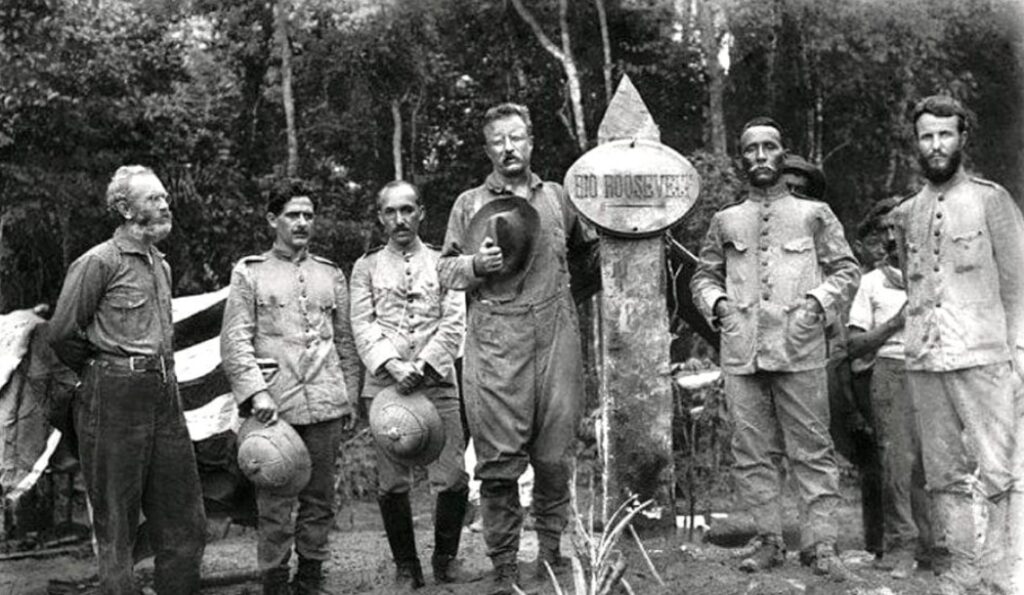
Then came the 1913-14 exploration of the River of Doubt. Roosevelt was at loose ends, having lost the presidential election of 1912. He and Colonel Rondon, a famous Brazilian explorer, along with Roosevelt’s son Kermit and others, mounted a trip to explore and survey the remote, only recently discovered, River of Doubt, deep in the Amazon jungle. Roosevelt knew this was dangerous, saying, “I have already lived and enjoyed as much of life as any nine other men I know. I have had my full share, and if it is necessary for me to leave my bones in South America, I am quite ready to do so.” This trip in the jungle almost killed them all. Of the 19 people who started the trip, only 16 finished, and those 16 barely survived. Starvation, hostile native tribes, treacherous waterfalls and rocky stretches of the river, alligators, piranhas, as well as tropical diseases, afflicted them all. They suffered from the torment of torrential rains, mosquitoes and stinging flies, festering wounds, malaria, and high fevers.
While navigating a rocky part of the river, Roosevelt’s right (his good) leg struck a rock, resulting in profuse bleeding. A deep abscess developed, causing high fever (and probable sepsis). This life-threatening illness was complicated by a severe malaria attack. Oral quinine, as well as quinine injections, seemed to make no difference. Roosevelt, once among the team’s strongest members, was reduced to being carried in a hammock or languishing in a canoe. He was raving and delirious much of the time, reciting repeatedly, “In Xanadu did Kubla Khan / A stately pleasure dome decree.” He lost over 50 pounds and suffered horribly. Afraid of being a burden, he repeatedly demanded to be left behind to die in the jungle, but his son Kermit refused. “There were a good many days, a good many mornings when I looked at Colonel Roosevelt and said to myself, he won’t be with us tonight,” naturalist George Cherrie later remembered. “And I would say the same in the evening, he can’t possibly live until morning.” In characteristic fashion, Roosevelt hung on. Eventually, the expedition’s physician drained the thigh abscess. There was no anesthesia, and Roosevelt was too ill to tell them he had a hidden vial of morphine (in case he needed to take his own life). The abscess later recurred in the buttock. Once the group finally reached civilization, Roosevelt received more medical attention, getting the abscess drained again, more quinine and heart medication. By the time their ship arrived in New York weeks later, he was strong enough to walk down the gangplank but was a shadow of his former self.
The leg wound continued to be a problem and 4 years later he was hospitalized for several weeks, for surgery on a fistula in that thigh and drainage of abscesses in both ears. He subsequently lost hearing in his left ear.
For the rest of his life, which was only five years after the River of Doubt, Roosevelt was plagued by a collection of ailments he called his “old Brazilian trouble.” What might have been these residual illnesses? Malaria can lead to kidney and lung failure and neurological deficits. His chronic bone infection could have caused rheumatic fever or bacterial endocarditis (a heart infection). There are many insect-borne illnesses endemic in Brazil that would never have been diagnosed in 1914 and could have caused chronic symptoms. These include Chikungunya, which in its chronic stage is well-known for causing exquisitely painful swollen joints and fever, as well as liver damage. Parasitic diseases such as Chagas Disease (Click here to see my blog about Darwin for more on Chagas) and schistosomiasis (fever, liver damage, anemia, chronic diarrhea) could also have contributed to Roosevelt’s rapid decline after his River of Doubt trip. Either way, Roosevelt always felt the trip had been worth it.
The poet Edgar Lee Masters described his last visit with TR:
… He’s drest in canvas khaki, flannel shirt.
Laced boots for farming, chopping trees, perhaps;
A stocky frame, curtains of skin on cheeks
Drained slightly of their fat; gash on the neck
Where pus was emptied lately; one eye dim
And growing dimmer; almost blind in that.
And when he walks he rolls a little like
A man whose youth is fading, like a cart
That rolls when springs are old. He is a moose,
Scarred, battered from the hunters, thickets, stones;
Some finest tips of antlers broken off.
And eyes where images of ancient things
Flit back and forth across them keeping still
A certain slumberous indifference
Or wisdom, it may be…
Wow!! The man was a cat. He survived at least 9 illnesses that could/should have killed him.
I’m glad I wasn’t his physician.
No joke!