
In the spirit of Christmas, I’ll ask- was Santa Claus a redhead? Lore and traditions link him to red-haired figures like Sinterklaas and St. Nicholas. Modern interpretations like the classic holiday movie, Santa Claus is Comin’ to Town (1970), suggest Santa was originally a redhead whose hair faded to white with age. So, let’s go with it!
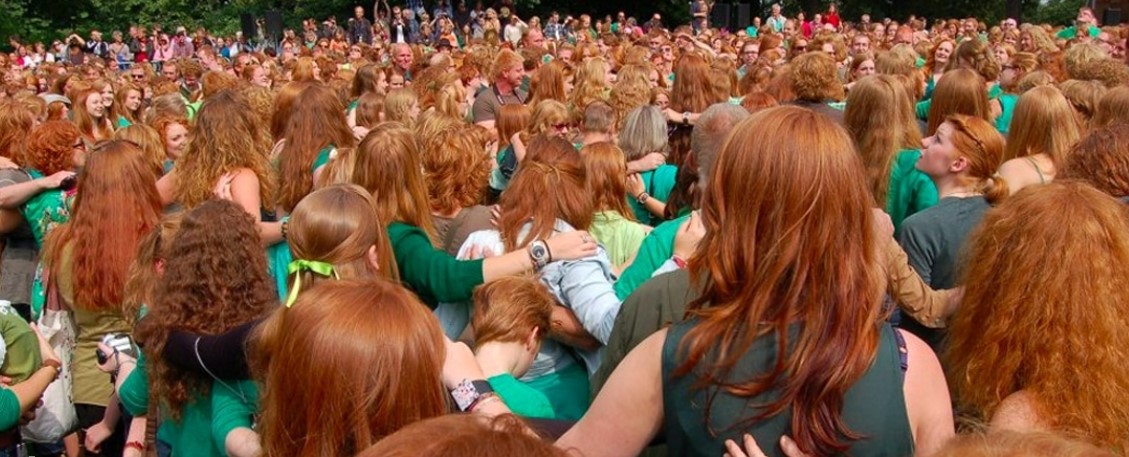
I’m a redhead, along with less than 2% of the world’s population. We are a rarity, though you’ll see more people who look like us in Ireland (13%) and Scotland (6%). There are lots of nicknames for redheads: ginger, carrot top, torch head, copperhead. We are all rumored to have quick tempers and be outgoing, funny, and tempestuous. There are plenty of famous redheads: Lucille Ball, Queen Elizabeth I, Reba McEntire, Thomas Jefferson, Vincent Van Gogh, and Galileo, to name a few.
To understand redheads, first we need a little review of genetics. Human cells have 46 pairs of chromosomes, half from each parent. Each chromosome is tightly packed with genes. We have about 46,000 genes, carrying all our DNA-based genetic information. Genes have specific jobs, many of which we have figured out. As more research is being done on the human genome, we are learning more about the genetic basis of many conditions. How redheads get their red hair is an interesting example.
All people get their pigmentation from melanin. Cells called melanocytes make two types of melanin- pheomelanins and eumelanin. Pheomelanins make red hair as well as the pink parts of our skin, like lips. Eumelanin creates darker skin and hair colors. Most people have more eumelanin than pheomelanin. Redheads, however, have a mutation in the MC1R gene on chromosome 16, so the melanocytes produce more pheomelanin and less eumelanin. Thus, lighter skin and red hair. Why so many different shades of red, then? Well, the MC1R gene is the primary factor controlling hair color but there are several other genes that influence the exact shade of the red hair. It’s a little like mixing paint, using red and brown pigments. A little pheomelanin with a lot of eumelanin yields strawberry blond. Lots of pheomelanin causes bright red hair. Auburn comes from lots of pheomelanin and lots of eumelanin.
Red hair is considered a recessive genetic trait, meaning you must inherit two copies of the mutated MC1R gene variant (one from each parent) in order to have red hair. If you inherit only one copy of mutated MC1R, you can carry the red-haired trait on to your children, but you won’t have red hair. Men with just one MC1R gene may grow red beards, however. Other traits appear to be genetically linked with red hair, like freckles, fair skin, and the inability to tan.
Personally, I believe it is a huge advantage to be a redhead. You never get lost in a crowd, you are memorable, you are expected to have a temper (So, you can get away with a little misbehavior.). Redheads’ fair skin and freckles can mask signs of aging like wrinkles. A study into “perceived age” was organized by the Erasmus University Medical Centre in the Netherlands. Photos of the make-up free faces of 2,693 people were assessed to see what age people thought they were. This was compared with their true age. Those with the MC1R gene variant were perceived to be about 2 years younger than their true age. Perhaps this is because the MC1R gene, while responsible for red hair and fair skin, also plays a part in biological processes like inflammation and DNA damage repair. Excellent results from my point of view! I’m feeling younger already!
Another perk of being a redhead is that redheads don’t go gray. Instead, when red hair follicles stop producing their warm, ginger pigment (the pheomelanin), the color begins to melt away from red through a spectrum of strawberry blond, then blonde and often ultimately silvery-white. But no gray. Bad news for my husband, who has always thought salt and pepper hair is beautiful on women. I have plenty of red pepper, but no black pepper!
Redheads have very efficient Vitamin D synthesis. They require lower levels of sunlight than others in order to produce needed amounts of Vitamin D. This was probably an evolutionary adaptation for survival in cloudier northern climates like Ireland, Scotland, and Norway. So, no Vitamin D deficiency rickets and less osteoporosis for us redheads!
Although the mechanism is not clear, studies show redheaded men have half the incidence of prostate cancer as other men.

There are a few downsides to being a redhead. All anesthesiologists know that redheads need as much as 20% more anesthesia than other people. Why? It is not clearly understood but it appears the mutation in MC1R also impacts how redheads respond to endorphins, our bodies’ own pain-relieving chemicals. Larger doses of opioid narcotics, local anesthetics like lidocaine and general inhaled anesthetics are often required for redheads. So, if you’re a natural redhead but have dyed your hair another color (why on earth?), please let your anesthesiologist know before your surgery!
There is an enduring medical rumor that redheads bleed more easily. I have certainly heard surgeons mutter during surgery when a patient is bleeding a lot, “Bleeding like a redhead.” However, clinical studies show that although redheads bruise more easily, they bleed and clot like everyone else.
The lack of eumelanin causes some critical issues. Melanin protects the skin from UV light. Redheads have less of that protection, so even without intense sun exposure, they are much more susceptible to UV-induced skin damage than individuals with darker skin. Redheads also can’t repair skin cells as well after UV exposure, further raising cancer risk. So, for redheads, the same amount of time in the sun as other people leads to more sunburn, more DNA damage in skin cells (acting like extra years of sun exposure), resulting in a 10- to 100-fold higher frequency of melanoma. Redheads, get that big floppy hat and the maximum strength sunscreen out! Get your annual skin check and keep your dermatologist on speed dial!
The MC1R gene has turned out to be a busy gene. It appears that this same redhead mutation in MC1R may also affect dopamine, the brain signaling chemical that is lost in Parkinson’s disease. One study indicated that individuals with red hair may have nearly a 50% higher risk of developing Parkinson’s compared to those with dark hair. There is active research ongoing about the link between Parkinson’s and the MC1R mutation.
There is an unusual situation in which a black-haired person’s hair may turn red. Kwashiorkor is a severe form of malnutrition caused by an extreme lack of protein in the diet and is common during periods of famine. Most common in children, the signs are weight loss, potbellies, swollen legs and feet, and gradual fading of dark hair to red. As it turns out, hair follicles need protein to produce melanin, the pigment that gives hair its color. When protein intake is severely lacking, melanin production falters, and hair color fades. I once took care of a child with kwashiorkor. It is strikingly rare in developed countries, and I had never seen a case before. This 4-year-old child had a severe eating disorder and purposefully vomited all food that was given to him, except for rice krispie treats. As it turned out, he had eaten only rice krispie treats for the past year. His parents, much more worried about his other symptoms, had thought nothing about the gradual fading of his hair color. Once we diagnosed his problem, and started balanced meals through a feeding tube, his swelling resolved, his potbelly shrank and his hair slowly returned to its previous glossy black color!
Now you know how special redheads are, from their hair all the way to their genes. Hug your favorite redhead today!
Being a mutant is not half bad. Hurray for redheads!
We’ve always known we are special!!
Nice work, Ann. Just passed this on to my two redheaded sisters. I will have to ask them if they eat rice crispy treats. That last story was a bit scary. Hope the kid is doing well now.
So lucky to have 2 redheaded sisters! I have one!