
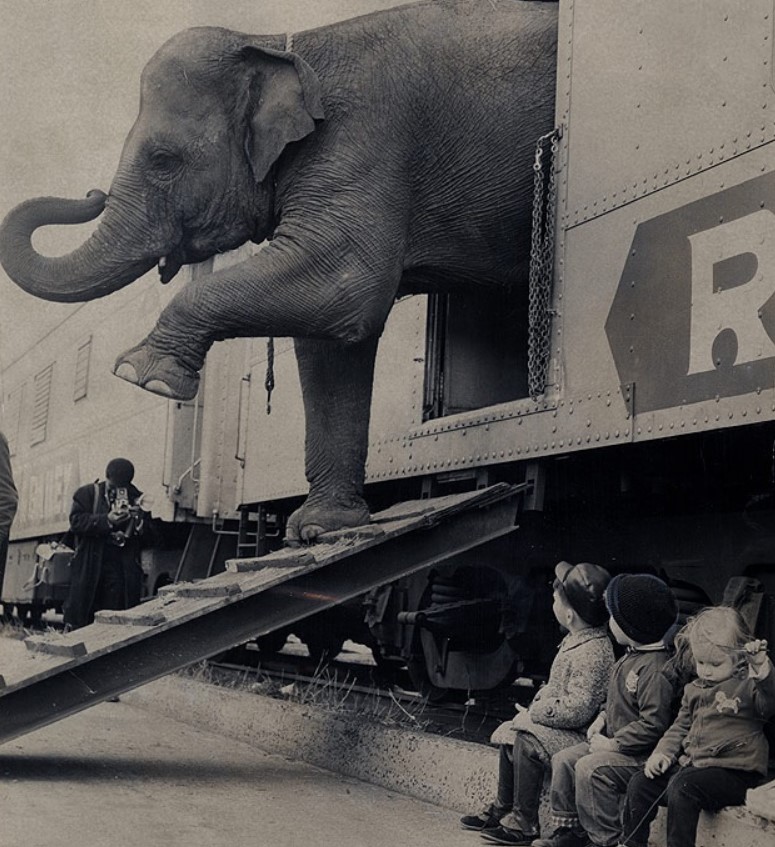
Those of you who are doctors will clearly remember dissecting your cadaver in Gross Anatomy class. So much to memorize, so many structures to learn, so much careful dissection to do! What if your professor gave you an elephant to dissect?!
That’s exactly what happened to the medical students at the then-brand-new medical school at Oglethorpe University in Atlanta, in 1941.
It all started when the Ringling Brothers Barnum & Bailey Circus train pulled into Atlanta on the morning of November 5, 1941. It was near the end of the circus’ tour (before wartime restrictions prevented their coast-to-coast travel). The elephants (47 in all) had finished setting up the Big Top tent and were grazing in a field near the Highland Avenue showgrounds. About noon, Lizzie, a 41-year-old elephant, began gasping for breath and quickly died. Shockingly, over the next five days, 10 elephants died. The hides of the dead elephants were sold to the Sterling Leather Works and made into luggage. The circus left Atlanta early, under this cloud of unexplained elephant deaths. At their next stop, Augusta, GA, two more elephants died!
Oglethorpe faculty member Dr. John Bernard learned about the dead elephants and arranged for some of his medical students to fetch one of the elephants, (the baby of the bunch, named Palm), on a flatbed truck. It was cool fall weather, and Palm lasted outside for a week, while the medical students dissected her, studying comparative anatomy. Once they were finished, a huge hole was dug, and the elephant carcass was rolled in and buried. There are no documents to tell us where Palm was buried, but legend tells us it was on land that is now covered by the library building. Freshmen are told if they listen carefully in the library, they can sometimes hear Palm trumpeting!
So, what about those dead elephants? Autopsies showed they all died from ingestion of massive amounts of arsenic. The elephant superintendent, Walter McClain, remembered that four years previously, eleven elephants had been accidentally poisoned when grazing on grass near a chemical plant in Charlotte, NC. The veterinarians who treated the recent sick and dying elephants were sure, however, that they had ingested much more poison than they would have gotten from eating poisoned grass. Everyone was sure they had been murdered.
Arsenic has been called “The Poison of Kings and the King of Poisons” due to its historical use, ready availability, high toxicity, and the fact that it is colorless, odorless, and tasteless when mixed with food or drink. Acute arsenic toxicity causes vomiting, diarrhea, difficulty breathing, paralysis, arrhythmias, hypotension, and rapid heartbeat. Symptoms usually appear within 1-2 hours of ingestion. The estimated lethal dose of arsenic for acute poisoning is 1 mg/kg of body weight. The average elephant weighs over 5000 kg, so a teaspoon of pure arsenic could have been deadly. Accurate testing for the presence of arsenic has been around since the late 1800s, so the people evaluating the elephants would have been able to be definitive about arsenic being the cause of death. The primary antidote, BAL (British Anti-Lewisite) wasn’t developed until later in the 1940s, so wasn’t available for these poor elephants. Plus, I can’t imagine anyone would have been able to come up with enough of it for 11 elephants!
The loss of these elephants was a huge problem for John Ringling North; he had lost over $125,000 ($1.8 million today) of valuable animals. North launched an investigation of giant (shall I say elephantine) proportions, hiring the famous Pinkerton Detective Agency to determine what had happened. They retraced the circus train stops from Danville VA, through Charlotte, NC, to Greenville, SC to Atlanta, checked samples of grass at each place the elephants had stopped, and researched poison and insecticide purchases at every feed and seed store in the vicinity. All drug stores in those towns were investigated to see if substantial amounts of arsenic had been purchased. No leads.
It became national news, and the papers had fun with headlines. “Murder of 10 Reported,” The Baltimore Evening Sun, “Mass Murder,” Tampa Bay Times, “Big Top Murder Case,” the New York Daily News.
There was an eight-state manhunt.
Pinkerton felt it had to have been an inside job. Eventually, Elwin Michael, one of the elephant train crew, was taken into custody in St. Petersburg, FL. A couple of circus fans interviewed in Gastonia, NC reported they had seen a man giving an elephant five large white capsules. They identified the hat Michael was wearing as the hat they saw at the time. Both witnesses picked him out of the 225 elephant loaders they looked at. A news clipping about the elephant poisoning was found in his possession. Then, a Danville, VA pharmacist reported a man fitting Michael’s description had tried to buy 50 arsenic capsules. Michael absolutely denied any involvement, saying he had been at the movies when the witnesses saw the elephants get the capsules. Then the witnesses began to contradict each other, the Danville pharmacist wasn’t sure of the description of the arsenic purchaser, Michael’s movie alibi held up, and the case against Michael unraveled. He was released. The police questioned several other suspects, including a recently fired circus worker, but there was not enough evidence to keep them.
In the end, everyone decided the elephants had accidentally gotten the arsenic when grazing in that same Charlotte field near the industrial plant.
It was an almost fatal blow for Ringling Brothers Barnum & Bailey Circus. The loss of eleven elephants was one-fourth of its herd, causing them to have to change many of their popular elephant acts. Pinkerton’s wide-ranging investigation had been eye-wateringly expensive. Additionally, Disney’s movie Dumbo came out that year, highlighting the sometimes-cruel treatment of circus animals, turning public opinion against the circus.
Then, on December 7, 1941, Pearl Harbor was attacked and the nation’s attention turned away from the mysterious elephant murders.
And there, the trail goes dead. 85 years later, how those elephants died is still a mystery. And Palm’s grave, somewhere on the Oglethorpe campus, remains a mystery as well. But I do love to think about being a first-year medical student and getting a sudden chance to dissect an elephant!
PS. For those of you who love Atlanta history, I’ll add that I wondered where all those dead elephants were buried. That knowledge was lost until 1961. That year, the RL Mathews Company contractors were building a private road for the Glidden Company, off Huber Street (near Chattahoochee Avenue). In 1941 this had been the site of the Atlanta Tallow Works. Their bulldozers unexpectedly dug up an elephant graveyard. They were unimpressed, re-buried the bones, and continued construction. So now we know the rest of the story!
Table 8 would have enjoyed the dissection. Surrounding tables would have “herd” and enjoyed our commentary.
Fabert, Ferris, Flamm and Fleming would have loved it as well!!
Where do you get this stuff????!!!