
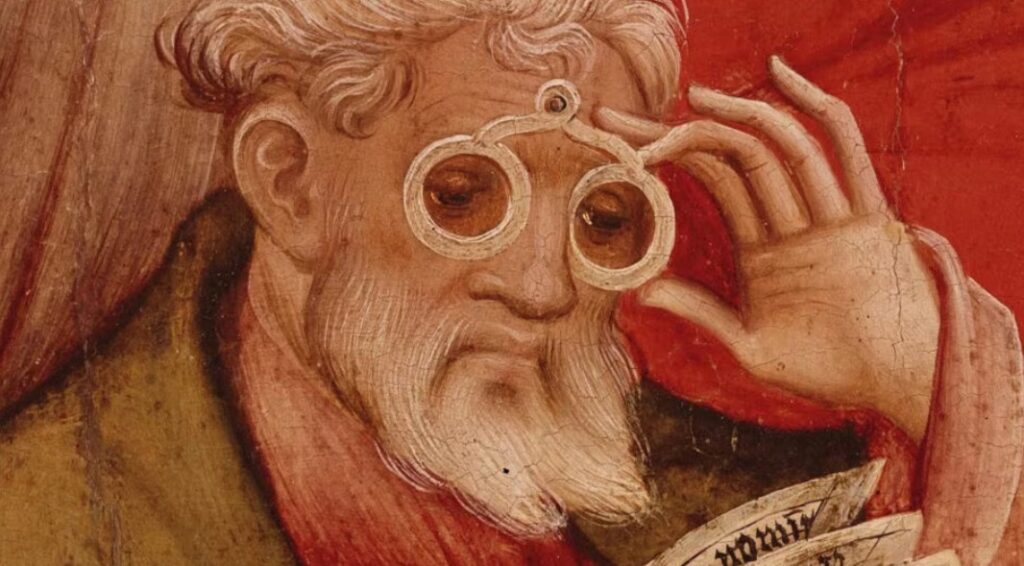
Are you wearing glasses or contacts to read this? If so, join the 75% of American adults who need some type of vision correction. Of that 75%, 64% wear prescription glasses. That means that almost 200 million Americans use glasses to see well. Only 15% of us who need vision correction use contacts (or some combo of glasses and contacts). Interestingly, almost half of all people who try contacts stop using them within the first two months. Eyeglasses are clearly easier and more popular.
If you lived before the 13th Century and had bad eyesight, you would have just had to put up with it. Greek and Roman writings are full of complaints about diminished vision, especially with age. Ancient Egyptian writing mentions vision trouble, and includes recipes for eye drops and lotions, but no comments about devices to improve vision. The Arab mathematician and astronomer Alhazen lived around 1000 CE and wrote a book, “The Treasure of the Optics”. He understood geometry, refraction, angles, and magnification of objects with oval lenses. However, this was all apparently theory, and he never developed any lenses himself. In 1240 his book was translated into Latin in Italy. Christian monks in monasteries, who spent their days reading and writing and copying manuscripts, were intensely interested in the possibility of vision improvement for their older brothers, as you can imagine. Venice was the center of clear glass production then, and monks there read Alhazen’s book, using the information to grind quartz or beryl into ovals called reading stones. (Imagine clear, slightly rounded paperweights, like magnifying glasses). These immensely popular reading stones, placed on a manuscript and slid across as the reader progressed, quickly spread across Europe.
By 1260, we begin to see art and writing about lenses held up to eyes to help with vision. The first of these eyeglasses were probably made in Italy; Pisa or Florence. Again, it was monks in monasteries who perfected this craft and quickly spread it to their brethren, to facilitate reading and writing. Venice quickly became the center of eyeglass manufacturing, because of the high quality of clear glassmaking at Murano. These early glasses were “Rivet spectacles”, that is, two lenses riveted together so that the handles gripped the nose. Lenses with a short handle, called Lorgnettes, were also popular. Ribbons attached to the lenses and tied behind the head were also popular for a while. It wasn’t until the 1700s that earpieces like we are used to came about.
By 1300, there were eyeglass-making guilds and regulations governing the sale of eyeglasses in Venice. By the 1400s, eyeglasses were common, and we see paintings of that era showing people holding glasses up to their faces. There are records of ships carrying thousands of eyeglasses in their manifests, traveling from Italy to the Middle East, and from there on to India and China. Remember that these were magnifying glasses. It wasn’t until the 1500s that lenses to correct near-sightedness and farsightedness were developed.
We have all heard that Benjamin Franklin invented bifocals. He was frustrated with continually having to switch from near vision glasses to far vision glasses, so he cut lenses from two pair of glasses in half, framed them together with far vision lenses on top and near vision on bottom, calling them “double spectacles.”
It’s interesting that wearing glasses has had different stigmas. Initially, monks wearing spectacles were seen as studious. But glasses were also seen as markers for someone pious and elderly, and probably weak. That began to change in the early 1900s in the US when the fantastically popular Teddy Roosevelt, who had terrible vision, was regularly seen (and photographed) wearing glasses. In the UK, eyeglass wearers were universally seen as weaklings, until the outstanding cricket player Tim Killick started wearing glasses while playing. Now glasses are accepted, and sometimes part of someone’s persona (I’m thinking of Buddy Holly, John Lennon, Superman/Clark Kent, Steve Urkel, and Harry Potter.). Some celebrities even continue to wear glasses after they have had vision correction surgery, like the comedian Drew Carey and rock star Elton John. Unbelievably, Elton admits to owning 250,000 pairs of glasses!
Notice all my examples are men? Well, the stigma against eyeglasses is stronger for women than men. Studies show that historically, women with glasses have been viewed as less attractive, less feminine and less confident, while men wearing glasses have been perceived as more intelligent and dependable. However, both women and men fall prey to the “nerd” stereotype, when wearing glasses.
Apparently, people haven’t forgotten Dorothy Parker’s famous 1926 two-line poem:
“Men seldom make passes
At girls who wear glasses.”
Perhaps this gender difference is why 2/3 of all contact wearers are women.
And we haven’t even talked about sunglasses yet! We know the Innuits created sunglasses to shield them from snow blindness. They used driftwood, caribou antlers or walrus ivory to form goggles to cover their eyes, with only tiny carved slits to let in some light. Emperor Nero watched gladiator battles by holding up a large emerald to block the sun; I suppose that counts. Early Chinese used lenses of smoky quartz to protect from the sun. In a fascinating twist, early Chinese judges also wore sunglasses to hide their facial expressions from others in the courtroom.
And all through the following centuries, people experimented with tinted lenses. Venetian noblewomen traveling by gondola adopted fashionable “gondola glasses”, or “vetri di dama”(lady glasses), green-tinted spectacles to protect them from the glare off the water.
But sunglasses didn’t really get cool until 1920s Hollywood when movie stars like Charlie Chaplin, Rudolph Valentino and Greta Garbo took to wearing them because studio lights were so bright. Quickly, sunglasses changed from something utilitarian to glamorous. Then came the 1938 Bausch & Lomb Aviators, developed by Colonel John Macready for test pilots, to block UV rays (hence the name Ray-Bans). They became standard issue three years later for American soldiers going to war. Then General Douglas MacArthur, Commander of the US forces in the Pacific, was almost never seen without his Aviators on (and his corncob pipe). Soldiers came home from the war with their Aviators, and they remained the essence of “cool” for the Greatest Generation. The Baby Boomers of the 1950s loved the next product from Ray-Ban, the Wayfarers. James Dean wore a pair in Rebel Without a Cause. Bob Dylan and the Beach Boys wore Wayfarers. The coolest man ever, Muhammed Ali, wore them. Don Henley’s big 1985 hit song “Boys of Summer” includes the iconic lyrics,
I can see you, your brown skin shining in the sun
You got your hair slicked back and those Wayfarers on…
Aviators had a huge resurgence with the movie Top Gun, featuring Tom Cruise as Maverick and his jet pilot buddies in their Aviators. Aviator sales in the US increased by 40%.
We can’t talk about movies without mentioning The Matrix. It holds the record for the most sunglasses worn in a film. You can even tell the good guys from the bad guys in this film by their glasses. All the “good guys” wear rounded or oval frames. All the agents, on the other hand, wear rectangular frames.
Eyeglasses and sunglasses have come a long way. We now have polarized lenses, color correcting lenses for color-blind people, glasses to help with macular degeneration, sport-specific lenses (yellow for snow sports, purple for shooting sports, blue-blocking for computer gamers), glasses for insomnia, and plastic lenses for impact sports. Space travel, with its exposure to intense solar radiation, has led to development of better UV protection, including thin layers of gold across spacesuit helmet lenses. Additionally, 90% of astronauts end up wearing corrective glasses in space because zero gravity changes the shape of eyeballs and affects visual acuity.
Less than 0.2% of all eyeglass wears opt for vision correction surgery, so I believe eyeglasses will be with us for a long, long time. And everyone needs cool sunglasses, right?
As one who wears contacts and glasses I have often said I owe so much to the ones who invented them. I had no idea only 15% of us who are visually impaired wear contacts. I wonder what the percentage is on those who were found to need glasses in our youth as opposed to those who need readers as they age. Again, thanks for doing the research for us.
Thanks, Joy. I’ve worn glasses since 2nd grade, then contacts, then glasses again, finally vision correction with cataract surgery. So this was all interesting for me to research, too!