
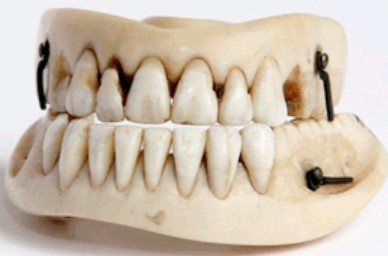
Last time, when I wrote about Wilbur Wright’s dental problems, I happened upon information so unexpected and interesting that I knew I had to tell you about it! Waterloo Teeth!
First, we need to talk a bit about cavities and the history of dentistry. Cavities have been around for as long as we have. There are cave paintings showing tooth problems. We can read about rotten teeth in ancient writings of the Egyptians, Assyrians, Etruscans, and Chinese. The ancient Greeks and Romans believed tiny worms caused holes in teeth, like termites in wood. Rudimentary tooth brushing sticks existed in many early cultures. But, dental problems, though prevalent, were not as widespread as they are now. Studies of remains from Pompeii (79 CE) suggest less than 20% of early Romans had dental caries. The diet in that time period on the Mediterranean was quite similar to what we call the Mediterranean diet now, fresh fruits and vegetables, lean meats, beans. All good for the teeth.
Granulated sugar, as we know it today, wasn’t developed until the 5th century in India. It spread to the Middle East and was carried back to Europe from the Holy Land during the Crusades. As sugar spread, so did cavities. During much of the Medieval period, poor peasants still had relatively healthy teeth; they couldn’t afford expensive sugar. It was the wealthy who began to be plagued by rotten teeth.
By the Renaissance, better devices were developed for extracting teeth, and the word “dentist” was first used. By the 1600s, the first dental textbooks appear. During the Industrial Revolution in the 1700-1800s there was a dramatic rise in sugary foods and baked confections, and dental disease became rampant. It is estimated that in the 1800s, 90% of people had dental caries.
So, what about dentures? Well, attempts to fill in for missing teeth had been around for centuries. The ancient Inca embedded seashells in the jawbones where teeth were missing. Carved wood mouthpieces with attached animal teeth have been found dating back to 700 BC in Northern Italy. In the 1600-1700s, dentures (the gum plates and the teeth) were carved from elephant or hippopotamus ivory. Porcelain teeth were made in France in the 1770s. Esthetically pleasing, they were, unfortunately, fragile. Wealthy people were demanding a better solution.
By 1781, we see an advertisement, showing that London ‘surgeon dentist’ Paul Jullion was charging two pounds and two shillings for ‘fitting and fixing a human tooth’. Fitting a full row of human teeth would cost a customer 31 pounds and 10 shillings, an impossible amount equal to two years’ worth of wages for an unskilled laborer.
We’ve all read that George Washington had wooden teeth. Nope. His were hippopotamus ivory with human teeth attached, cutting edge (no pun intended) for the time.
But where were these human teeth coming from? We know about grave robbers (Resurrectionists) who surreptitiously supplied bodies for anatomical dissection. It turns out, they also pulled teeth from corpses and sold them to dentists as a lucrative business. Desperate peasants sometimes sold their teeth to tooth sellers and denture-makers (Remember Fantine, Cosette’s mother in Les Misérables? She sold her hair and eventually her front teeth.). By the early 1800s, with a growing demand for human teeth for dentures, customers began to develop ethical dilemmas and concerns about exactly where those teeth were coming from. In response, dentists began seeking alternative sources for their dentures, and they found it in an unlikely place: the battlefield.
1815 was notable for the decisive battle of its age, the fateful Battle of Waterloo, Napoleon’s final defeat by the Duke of Wellington. The numbers are astonishing; over the 23 years of the Napoleonic Wars, over 6 million soldiers were killed. On the single day of the Battle of Waterloo, over 60,000 soldiers died.
Immediately after the battle, as expected, the looters came. (It is estimated that armies of this time were followed by about as many looters, cooks, families, prostitutes, etc., as there were soldiers.) Those looters supported themselves by reselling the clothes, weapons, medals, boots, horses, etc. that could be scavenged after battles. Dead soldiers were often stripped naked, and everything was taken and sold.
One German account, from 1815, reads: ‘Among all these loot-seekers, the most peculiar were those who broke open the jaws of the dead and tore out the most beautiful and whitest teeth, in order to subsequently sell them for implantation. The author heard that such teeth, which are seldom to be had, and in their place, one must always make do with calves’ teeth, are very dearly paid for.’
These hundreds of thousands of pretty teeth, from generally healthy young men, were cleaned, boiled, and shipped by the barrel full back to England, where blacksmiths, jewelers and dentists made them into dentures. There was much patriotic fervor after Wellington’s defeat of Napolean, and anything mentioning the Duke of Wellington or Waterloo became exceedingly popular. Many people felt there was a certain cachet to having dentures with teeth from brave British soldiers who had died defeating Napoleon. “Waterloo Teeth” became the common name for human-tooth dentures then; this effective marketing name masked the fact that some teeth were still from executed convicts or other more mundane sources. But the incredible availability of human teeth after Waterloo (and the other battles of the Napoleonic Wars) made dentures more popular and affordable for everyone.
According to the British Dental Association, “Waterloo Teeth” appeared in dental supply catalogs well into the 1860s. And it wasn’t just in England. The American Civil War, also incredibly costly in terms of human lives, left over 600,000 soldiers dead (almost 3% of the US population). Looting was the same in those Civil War battles. Shipping manifests of the period show barrels and barrels of teeth being shipped from the US to Europe for use in dentures, and ads for Civil War teeth can also be found in dental catalogues.
But alternatives were coming on the market. In 1838, sturdier porcelain teeth, called “incorruptible teeth” started to gain popularity. They could be shaped to fit and match, and were more durable than human teeth. In 1839, Charles Goodyear accidentally dropped a mixture of rubber and sulfur on a hot stove, and discovered it created a rubber that was moldable, durable, and non-sticky. This Vulcanized rubber (named after Vulcan, the Roman god of fire and metalworking) turned out to be the perfect product for dentures, and was much more comfortable and hygienic than previously used ivory or metal.
Then, the 1832 Anatomy Act in the UK, which regulated the use of human corpses for medical purposes, squelched the grave robbing trade and sharply curtailed the use of human teeth. By the late 1800s, the use of human teeth in dentures had largely faded away.
As it turns out, teeth were not the only thing shipped back to England after the Napoleonic Wars. Millions (yes, millions) of bushels of human bones, harvested from the many battlefields of Europe, were shipped to England, ground up in Yorkshire bone-grinding factories, and used for fertilizer all over the country. But that is too macabre for me to go into detail about, so I will end this grisly story here.
Fascinating!
Also, sad to learn about human “vultures” scavenging battlefields.