
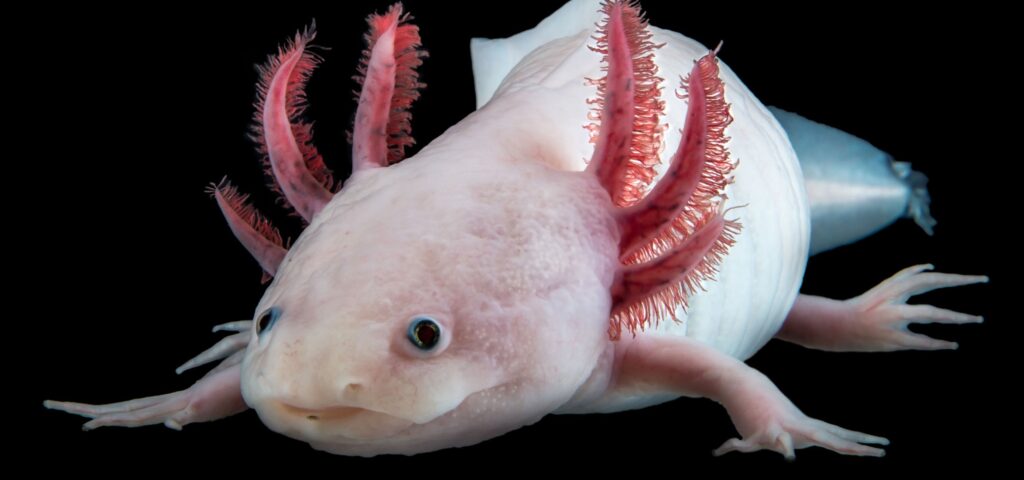
Fishermen used to chop up starfish, trying to get rid of them. Little did they know, if you cut a starfish into bits, any piece that retains part of the central hub will regrow into a whole new starfish! Lizards and amphibians can drop their tail if they need to escape a predator. They later grow their tail back. (And yes, it is disconcerting to catch a blue-tailed skink, only to be left with a wriggling tail in your hand. Ask me how I know.) Deer shed, and then regrow, their antlers every year. And the champion regenerator of them all, the axolotl, a super-cute aquatic Mexican salamander, can perfectly regrow limbs, tails, even some organ parts!
Why can’t we? Actually, we do have very limited regenerative capabilities. We regrow hair and skin our whole lives. We can heal and reshape bone after a fracture. We can regrow fingertips- if they are lost in early childhood. We can regrow our liver, even after losing as much as 75% of it. That’s why living donors can give part of their liver to a recipient; the residual liver will grow back to normal size. (I’m reminded of Prometheus, who gave mortals fire. Zeus was angry about it, so he chained him to a rock, and had a giant eagle eat his liver out each day. Every night, his liver grew back. Ouch! But I digress…)
Unfortunately, we totally fail at regenerating anything else our bodies lose. Arms, legs, eyes, lungs, kidneys. Once they are gone, they are gone. That’s why there has been so much research into organ transplants, limb reattachment surgery, and face transplants. Perhaps that’s why we read books about regeneration (Like Madeleine L’Engle’s The Arm of the Starfish) and watch movies with regeneration themes (like the James Bond thriller Die Another Day).
What do those reptiles and amphibians have that we don’t have? When an axolotl loses a leg, a blood clot forms at the stump. Quickly, new skin cells cover the area, and underneath them something called a blastema (from the Greek for offspring) forms. It contains complex new precursor cells, which rapidly develop into new tissues and structures that will form the new limb. It turns out the cells at the injury site have a lot of extra stored mRNA, which signal production of extra proteins and provide a template for the new limb. An axolotl can make a new leg in 40-50 days!
Humans, in contrast, have a robust response to close off a wound and form a scar after an injury/amputation. This saves us from bleeding to death, but it prevents formation of a blastema, and also decreases the amount of protein in the injured area. The exact opposite of the axolotl.
But humans are curious creatures, so there has been a lot of research into regenerative possibilities. That curiosity goes back at least to Aristotle, who wrote about regeneration of salamander limbs and deer antlers. In the 1700s, Lazzaro Spallanzani, a Catholic priest and biologist, wondered about how lizards could regrow their tails. He did experiments, made drawings and published results. In 1901, Nobel Prize-winning biologist Thomas Morgan wrote the landmark textbook Regeneration, compiling others’ observations and listing the main questions that needed to be solved about limb regeneration. And the research has continued.
Now, almost all research labs working on limb regeneration use axolotls. One of the big hold ups in axolotl research has been the extreme difficulty in sequencing the genome. It turns out that the axolotl’s genome is enormous, 32 million base pairs (about 10 times longer than ours!). However, it has finally been sequenced, paving the way for concerted work on which genes are important for regeneration.
Jessica Whited and her team in The Axolotl Project at Harvard are very focused on the blastema, that little nubbin of cells that starts the regeneration process. They are working on discovering key genes that axolotls switch on to create a limb from scratch. Additionally, they have found that an injury revs up the sympathetic nervous system (commonly called the “fight or flight” system), stimulating the rest of the salamander’s body to get ready in case there are more injuries.
James Monaghan’s lab at Northeastern University in Boston is creating fluorescent axolotls. They can then exchange grafts of tissue between red fluorescing and green fluorescing axolotls and track the migration of cells during regeneration. They are also studying the animal’s epigenome (Think of an epigenome as a package of chemicals that function to switch genes off and on.). Part of an axolotl’s epigenome appears to give cells spatial information. This research can help answer questions like, how does a salamander know which leg it is regenerating, and how does it know if the amputation happened at the hand or elbow, or how does it know when the new limb has gotten to the right size, or why does an axolotl stop regenerating after five amputations? So many questions to answer!
Researchers at Duke and Wake Forest have found a few genes shared by axolotls and some mammals. They’ve used genetic editing to switch on some regenerative processes in mammalian models, causing some bone regrowth.
Viennese biologists have found that there is a specific gene which acts as a 3D map telling cells where and what to grow. It looks like humans posses a dormant copy of this gene, so studying it could yield important information.
Most intriguing to me is the possible link between limb regeneration and cancer. Axolotls almost never develop cancer. In 1952, Charles Breedis, a researcher, injected some axolotls with coal tar, a carcinogen. Very few developed cancer, but many sprouted an extra arm! So why might a carcinogen trigger cancer (unchecked cell growth) in humans, and limb regeneration (a different kind of rapid cell growth) in these salamanders? What is the difference? Early research shows that axolotls have enhanced tumor suppressor genes. Research at Stanford shows that extracts from axolotls can arrest cell multiplication in certain human cancer cells. This seems like a hotbed for more intriguing research.
Axolotls are fascinating! They have been popular pets and research animals for a long time, and there is a large population of captive bred axolotls. Wild ones are critically endangered. There are probably less than 1000 adults remaining in their natural habitat, the wetlands of Lake Xochimilco in Mexico City. Thankfully, there’s an international conservation team working to help axolotls.
Save the cute and mysterious axolotls!!
Ann
This is very interesting
I applaud your ability to find these gems
Ted
I think this is a great article. Thank you for creating it for us.
So glad you enjoyed it!
I enjoyed your post.
Never thought about this before. With all this research, future humans will probably be able to regrow lost body parts.
Glad you enjoyed it!
Very interesting as always!
Thanks!