
I’ve been enjoying a TV series called “Unforgettable”. It’s about a detective who has perfect recall of every event she has experienced in her life. This rare trait helps her solve murder cases, of course. In truth, there are fewer than 100 documented people in the world with this ability, called hyperthymesia. Nobody really knows how it works or why those few people have it. It appears to be a blessing and a curse as they can’t forget anything, even useless memories like what they ate on September 12, 2000, or sad memories like mean things a first-grade classmate said. It makes me wonder how memory works.
What’s your earliest memory? Maybe your third or fourth birthday party? A beloved pet, or the arrival of a younger brother or sister? I remember my fuzzy blanket, pink on one side, blue on the other. I carried it everywhere until I was about four.
Why don’t we have memories further back than age three or four? Why can’t we remember when we were babies? This lack of memory for our early years is called “Infantile Amnesia”.
We are learning at the speed of light for the first few years of our lives, but we don’t remember much of it. Most of us have some memories starting around four years old, some people can remember events as early as when they were three. But we don’t remember being born or being infants or toddlers. Our brains grow tremendously during our early years. At birth, the brain is one-quarter of adult size, and by our second birthday, it has grown to three-quarters of adult size. Does that rapid brain growth have something to do with our memory? Or lack of it?
Now, I’m talking about what we call “episodic memories”, memories of specific events, not memories that accumulate, like how to talk, walk, feed ourselves.
Freud believed, of course, that we couldn’t remember infancy because we were repressing incidences of sexual abuse. Really, Sigmund? All of us??
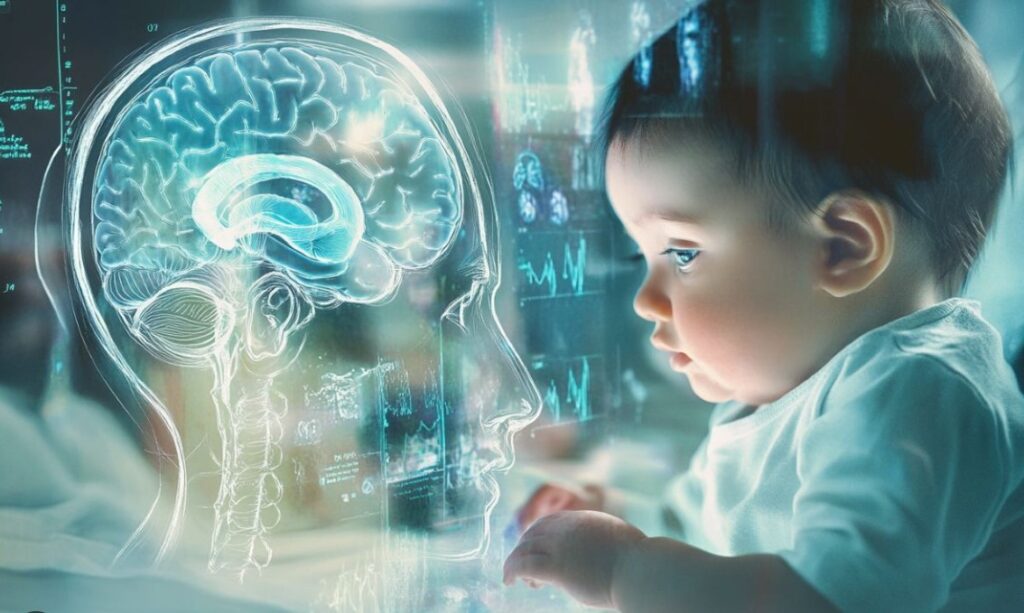
Several parts of the brain are responsible for storing memories. The most important memory part of the brain seems to be the hippocampus. The hippocampus, a seahorse shaped structure deep in the brain (You actually have two; one in each hemisphere.), is responsible for memory consolidation. It is like a save button, taking short-term memories and turning them into long-term memories. The hippocampus also links emotions and sensory experiences to memories (like how you feel when you smell baking bread or newly mown grass). It helps with spatial navigation, so you can remember directions to places. At birth, the hippocampus is quite immature and underdeveloped in humans. Scientists believe that, in a baby’s brain, new neurons and synapses are developing at such a rapid pace that newly formed memory circuits can override or overwrite previous memories (kind of like pruning a bush), so early memories aren’t retained. Thus, infantile amnesia. Additionally, we need language to tell a story of a memory, as well as a developed sense of “self”. These don’t exist in newborns; speech begins late in the first year and sense of self even later. So, theoretically, we are saving early memories; we just can’t convert them into long-term memories. We remember things we continue to use, like how to walk, or what Mom looks like, but we don’t remember specific episodes, like the day we first had baby food, or our first birthday party.
This idea of the immature hippocampus not being able to retain memories is being challenged by some ingenious researchers at Yale and Columbia Universities. How in the world did they do research on infants too young to follow instructions or talk? First, they developed excellent infant-sized noise-cancelling headphones. Then they snuggled the babies, ages four months to two years old, comfortably in warm blankets and tucked them into the functional MRI machine (A functional MRI, as opposed to a regular MRI, can give you pictures of which parts of the brain are reacting to something at the moment.). Then, on a screen close to their face, they showed them pictures of faces, objects, or scenes. They later showed them a new picture paired with a picture they had seen before. They found that babies looked at the familiar picture longer than the new picture, indicating they remembered it. They could see the memory area of the hippocampus light up more on the MRI when familiar pictures were shown. These findings were true in all the babies, but the results were stronger and more obvious in babies over 12 months old, giving some hints about how and when the hippocampus starts to develop.
So, memories are being made very early in our lives. How long do they last? Experiments in which toddlers were taught how to imitate an action (pressing a lever to make a toy train go) showed that six-month-olds could remember it for 24 hours, 9-month-olds could remember for one month, and 2-year-olds could remember for an entire year. Age isn’t the whole story; language seems important, too. Toddlers who had been in emergency rooms were interviewed and asked about their experience later. Those over 26 months at the time could recall it up to five years later, but those under 26 months (less verbal) recalled little or nothing. Perhaps preverbal memories are lost if they cannot be translated into language.
So, now we know we do make early memories as babies. What happens to them? Maybe they were short-term memories and were never converted into long-term memories (a failure of encoding). Or perhaps those memories are still there, and we can’t access them (a failure of retrieval). That’s what the Yale team is working on now. In their studies, infant mice learned how to navigate a maze and escape. Once those mice grew up, they no longer remembered the escape route. However, the researchers were able to use some molecular tagging methods to know exactly where the maze memory was stored in the mice’s hippocampus. (Now that is crazy cool technology! Don’t ask me to explain it.) When they stimulated that exact spot in the adult mice’s brains, the mice were able to navigate the maze without problems. So, the memory was there, it just couldn’t be retrieved.
Thus, it now looks like we have latent memories from infancy that we just can’t access. As Turk-Browne from Yale says, “this research suggests… that even though we later in life don’t remember those first few years, actually, there are memories being formed that are influencing our identity and our behavior, even if we can’t consciously recollect them.” Perhaps those memories are just waiting, in our subconscious.
Mouse research also shows that mice who seemed to have forgotten something could have their memory triggered by a reminder. Research on this is ongoing. Hmmmm, perhaps this explains why early childhood trauma can influence adult behavior. If those old memories are really there, what does this mean for stroke victims who need to learn to talk or walk again? Or patients with traumatic brain injuries? Is there a way to unleash those hidden memories?
What a paradox. We can’t remember our first few years, yet they are powerful in shaping who we are.
I’m amazed that a two year-old with an attention span measured in seconds can remember anything. 🙂
I know, right??
I’ve often thought about how much we pour into our little ones knowing full well that if we separate or die before they reach five or six they won’t even remember us. Kind of sad to think about. Thanks for shedding a little light on my faded memories.
So, now it looks like all those memories are still in there somewhere. Encouraging!