
Annelise Blanchette, a biologist working on her PhD in ecology and evolutionary biology, was deep into her research on lead levels and mockingbirds in New Orleans when the Covid pandemic changed everything.
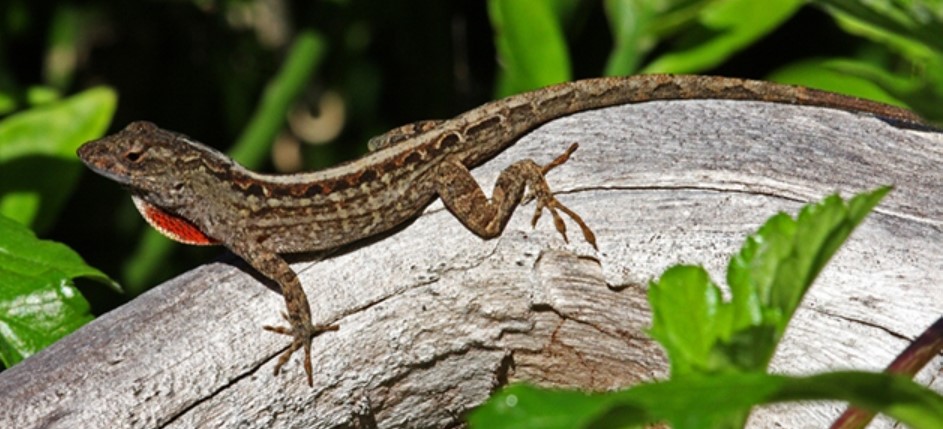
She and her team were locating mockingbird nests, trapping and banding birds, drawing a morsel of blood and extracting one feather from each bird to test for lead, and comparing levels in birds living in different neighborhoods. Then came the shutdown. She could no longer get together with her team, and couldn’t handle the equipment to trap the birds on her own. What to do? Two years of research down the drain? Not so fast. In a moment of inspiration, she thought about the Cuban Brown Anole, the ubiquitous little brown lizard she saw everywhere in New Orleans. Small, easy to catch, and hardy, perhaps they could be used to run the same study. She began catching them by hand on her way to the lab every day.
New Orleans is an old city, with lots of buildings with lead-based paint, lead pipes, and tons of Mardi Gras beads covered in lead-based paint that get discarded each year (see here, I’ve written about that too). Just like mockingbirds, the anoles absorb lead when they eat tiny insects that live in and on the ground, and when they get covered in lead-filled dirt and dust. A study using anoles could answer the same question Blanchette was asking: Can lead levels in animals tell us about lead exposure in the people living in the same neighborhoods? Can anoles be the “canary in the coal mine”?
What Blanchette found was confounding and unexpected and unprecedented.
But first, let’s talk about lead and why lead exposure is such a problem. Humans have used lead for thousands of years. Ancient Egyptians used lead to glaze pottery around 3-4000 BC. China had lead coins in 2000 BC. Romans used lead for pipes and as a sweetener in wine in the 100-400 AD era. Some people feel the high prevalence of lead poisoning in Rome contributed to the fall of the Roman Empire. In the Middle Ages, lead was used in roofing and stained-glass windows. Even in ancient Rome, people understood heavy lead exposure was dangerous, but not a lot of attention was paid to this issue until the 1700s. Lead poisoning causes anemia, kidney failure, memory problems, abdominal pain, fertility problems. High levels can cause seizures, coma and death. (Remember Beethoven’s hair?) In the modern era, it wasn’t until 1979 that the connection between lead exposure and cognitive and developmental problems in children was proven. A ban on leaded gas in the US followed. Lead containing paint was banned in 1978, but there are still millions of homes with layers and layers of old lead-based paint, covered by newer paint. That old paint continues to chip, flake, and contaminate the ground around houses. We all remember the horrible lead problem in Flint, Michigan a few years ago, when a change in water supply caused increased lead levels in the water, and in thousands of people living there. Lead doesn’t decompose, it remains in the environment as a contaminant, so even after those bans, the problem lingers.
It’s not just humans who suffer from lead exposure. The majestic California Condors were almost extinct, with only 22 known birds, in 1967. Scavengers, they often feed on dead animals killed by hunters, or gut piles left after hunters clean animals. These contain lead shot, which then poisons the birds. A captive condor breeding program brought condors back from the brink, but they, and other birds of prey, like eagles, hawks and owls, continue to suffer from lead poisoning. California is the only state in the union that has banned lead ammunition, though federal law requires non-lead ammo for waterfowl hunting in all states. Swallowed fishing tackle (which is usually lead) is still a problem for birds like eagles and osprey, that eat a lot of fish.
So, we can all agree that lead isn’t good for us, or other animals.
So back to the humble brown anole. Blanchette expected to find elevated lead levels in the anoles from neighborhoods with historically elevated lead levels in the soil. And boy, did she! Serum lead levels in the anoles were 1,000µg/dl to 3000µg/dl – higher than ever seen in ANY other living animal! For reference, we admit children to the hospital for treatment with levels of 4 or higher. Raptor centers frequently treat sick birds of prey with levels in the 50-60 range. The condors we just talked about had levels less than 100 and they were sick and dying.
Maybe reptiles are different, you say? Nile crocodiles often swallow fishing weights, so almost all crocodiles tested have elevated lead levels, usually in the 300 range. Ones with levels up to 3000 were sick, had blackened teeth, and were markedly anemic. But those anoles? Healthy, active, feeling fine!
Testing of the anoles (balance, sprint speed and endurance) was done with tiny balance beams, a little sprint track and a motorized treadmill. (I’m so sorry I don’t have a video of this to show you!) Regardless of their lead levels, the anoles mastered these tests without problems. Then, Blanchette and her team (Covid bans were lifted by now) began to feed the anoles meals of lead, pushing their levels higher and higher and re-testing them in the anole gym. It wasn’t until blood lead levels reached 10,600 (!) that the anoles slowed down in the gym and lost their appetite.
How in the world are anoles so lead tolerant? Cuban Brown Anoles are an invasive species and have been in New Orleans since the 1960s. That’s about 20 anole generations. Has that been enough time for them to evolve to handle the lead in their environment? Perhaps. Genetic studies done by Blanchette and her team are preliminary, but they point toward differences in some genes related to oxygen delivery (which is impacted by lead) and the way cells manage concentrations of metals. I’ll be curious to see what more research on this topic shows us.
Why do we care about the anoles and their crazy lead levels? Alex Gunderson, an evolutionary biologist at Tulane, on the team with Blanchette, says, “We need to reevaluate what we know about toxicity thresholds in vertebrates. If we can figure out what’s protecting them, we might uncover strategies that could help mitigate heavy metal poisoning in people and other species.” And for now, it is clear that the anoles can serve as a proxy, telling us about environmental lead exposure. “If you catch a lizard and it has high lead, it probably means that humans living in that area have higher risk of exposure,” Gunderson tells us. And it is certainly easier to test these little lizards than people.
Forget about mockingbirds. Let’s hear it for the mighty brown anole, leading (!) the way to keeping us safe from lead poisoning.
And, I might guess, the migration habits of anole are more confined than the mockingbird? Important given this is a geographically based study. Very interesting. Thank you, Ann.
Interesting thought! As it turns out, mockingbirds are year-round residents of New Orleans and do not migrate. But that could have added a confounding variable…..