
With Covid in the rear-view mirror, I put my Covid immunization card and an N-95 mask in my memory box, for children and grandchildren to see one day. What do you associate with Covid? What do you think people will think of 100 years in the future when they read about Covid? Isolation? The rise of Zoom? Mask arguments?
This led me to think about the great influenza pandemic of 1918. In the pre-television, pre-internet era, you would expect lots of art in response to this terrible pandemic. After all, over 1/3 of the world’s population got influenza, and over 100 million people died (compared to an estimated 20 million deaths from Covid). More than half of all U.S. military casualties in World War I were from the flu, not combat. It was uniquely devastating due to the rapidity with which it spread and the fact that it was particularly fatal for young healthy adults.
But, in fact, there’s not a lot in art of the period regarding the influenza pandemic. Perhaps it is because it happened at the same time as World War I, which overshadowed everything. Perhaps people were more private in their grief then. Perhaps it is because many artists died young during this pandemic. At any rate, there are a few interesting standouts in the art world, painters and writers who responded to the terror and grief of the time.
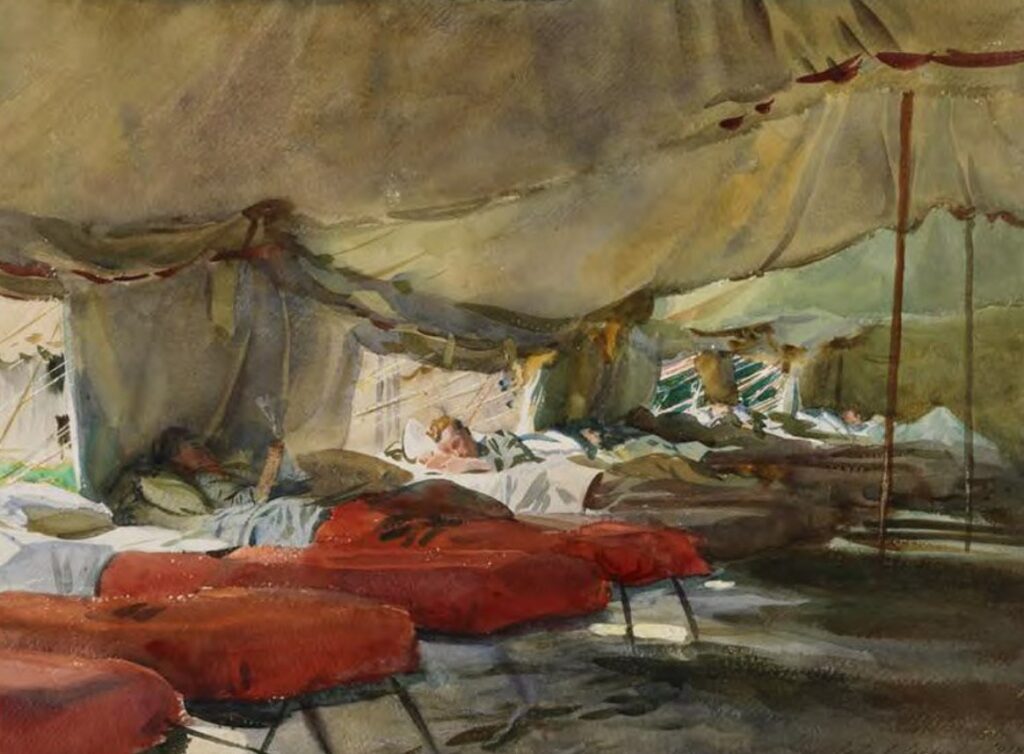
John Singer Sargent was one of the most famous painters of his day, and was particularly known for portraits (Claude Monet, August Rodin, Robert Louis Stevenson, Theodore Roosevelt, John D. Rockefeller, and of course, the infamous Madame X). In 1918 the British War Memorials Committee commissioned Sargent to sketch British and American troops in combat (which led to his iconic painting Gassed). He went to northern France to observe and draw soldiers, and there, became quite ill with influenza. He ended up convalescing in a military tent with soldiers who were wounded or ill with flu. Notice the painting Interior of a Hospital Tent; those beds with red blankets are contagious soldiers with influenza. The brown blankets indicate wounded or noncontagious patients. The person propped up in bed in the fourth red blanketed bed reading is probably Sargent himself. For the rest of his life, Sargent remembered it as an awful experience, writing that he tried to sleep, “with the accompaniment of groans of wounded, and the chokings and coughing of gassed men, which was a nightmare. It always seemed strange on opening one’s eyes to see the level cots and the dimly lit long tent looking so calm, when one was dozing in pandemonium.”
What treatment would he and the others in that tent have gotten? Not much. Viruses had not been discovered yet; the etiology of the influenza was not clear. There were no antibiotics, and no specific treatments. Respiratory death often came quickly; once the lungs became inflamed and filled up with fluid (we now call it ARDS- adult respiratory distress syndrome), there was not much technology to help. Devices for storing oxygen were first invented around 1900, and an apparatus was designed during WWI to treat gassed soldiers. So, there may have been supplemental oxygen, but no ventilators. IV saline was a brand-new technology, available as battlefield medicine only, so they may have gotten that, if they were unable to drink. Nurses and doctors provided mostly supportive care, such as fresh air, nutritious foods, lots of liquids, aspirin and perhaps quinine. There were alternative remedies with no proven value, but people were desperate, so they tried chlorinated soda water, goose grease salves, or laxatives to purge the body (Remind you of ivermectin, anyone?). Recovery, when it happened, was agonizingly slow.
We all remember Edvard Munch’s painting, The Scream. Well, that was painted in 1895, long before the flu. He was asthmatic, and always sickly as a child. He nearly died from tuberculosis. All his family died, one after another, when he was a child or young man. He was morbidly fascinated with death, and had painted several paintings of deathbed scenes and sick children. Then, in 1919, he fell ill with influenza and assumed he would die. Interestingly, he did use an oxygen cannister and mask (the most modern thing available at the time) while he was sick. He was quite ill and had a long convalescence. He painted two self-portraits, one while he was still sick, and the next while he was recovering. (see here) He looks pretty rough, doesn’t he? After he recovered, a visitor admired the first painting in his studio. Munch asked,
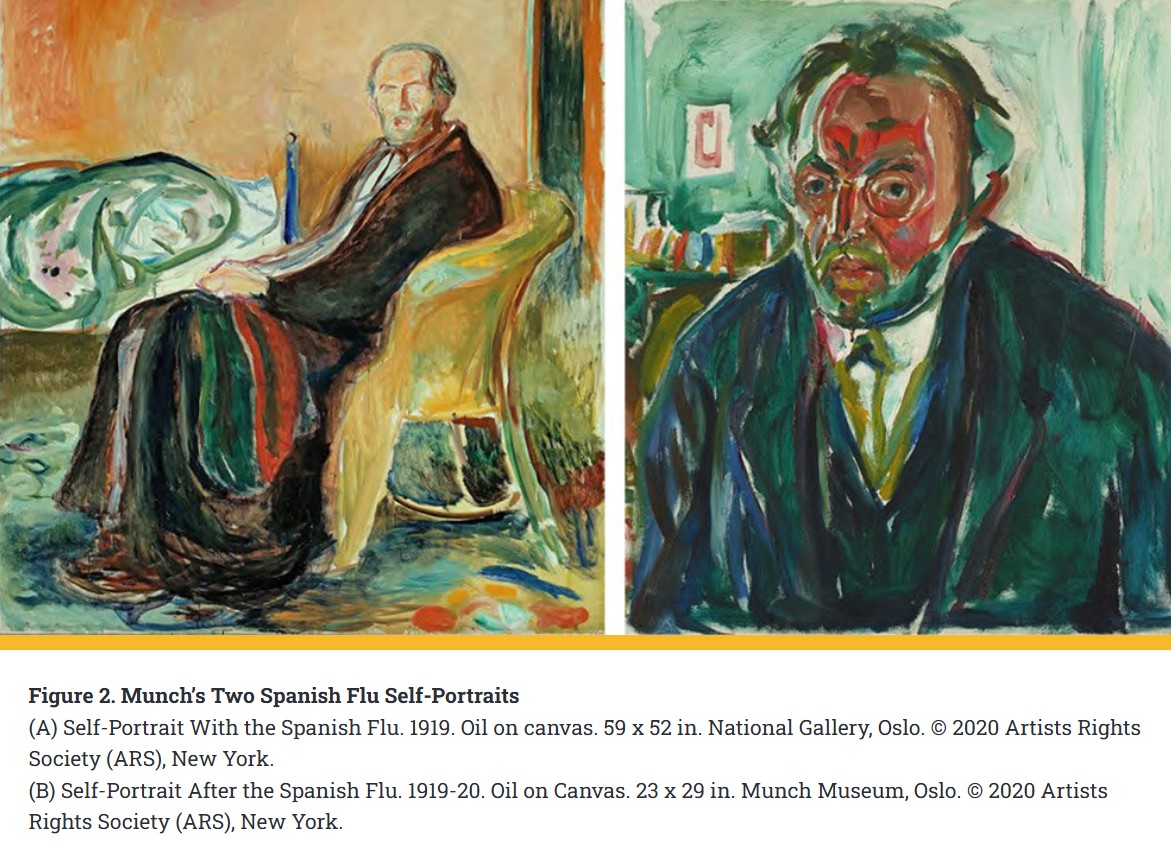
“Does it feel nauseating?”
“What do you mean?”
“Can you sense the smell?”
“The smell!?”
“Yes, can’t you see I’m at the point of decomposing?”
Luckily, he was wrong about his own decomposing (!) and went on to live another 25 years.
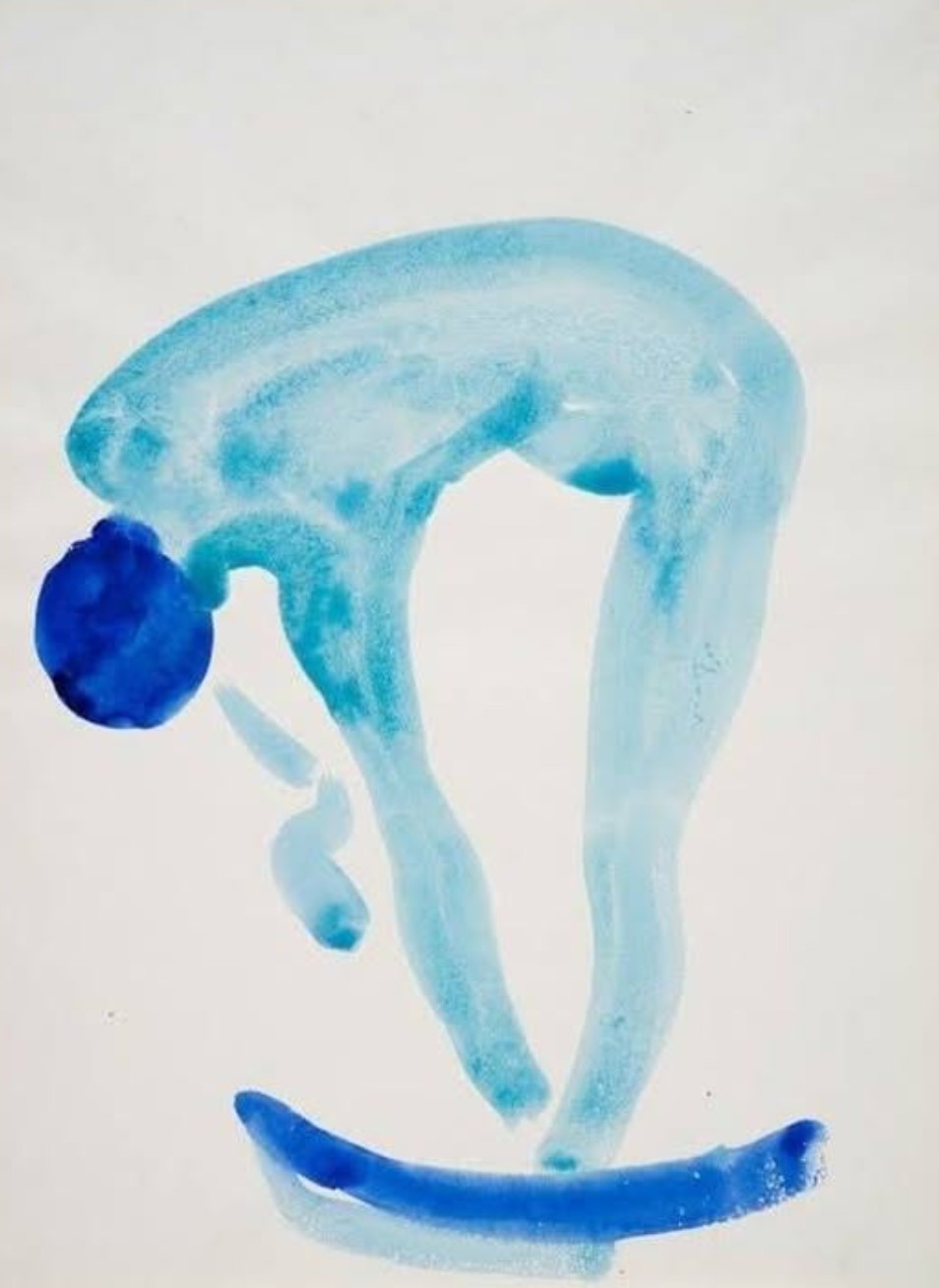
Georgia O’Keefe, beloved American painter, was teaching in Canyon, Texas in 1918 when she contracted influenza. She had a prolonged recovery, taking a leave of absence from her job to recover at a friend’s ranch in San Antonio. Already dealing with depression, she said as she convalesced, “Everything seems to be whirling or unbalanced—I’m suspended in the air.” She painted a series of nudes and self-portraits as she recovered; perhaps the only time in her career she did so. (see here) O’Keefe and the famed photographer Alfred Steiglitz had begun a regular correspondence a few years earlier and he had organized shows of her work in New York. A relationship developed and he urged her to come to New York to continue to recover from her bout of influenza. She resigned from her teaching job, and with assistance (she was still weak) traveled to New York, where their passionate love affair began. Would his wonderful photography of her, her cutting-edge paintings of New York and huge flowers, and their years of collaboration have happened without her influenza illness? Impossible to know.
Painting was not the only art changed by the pandemic. There is a very long history of the intersection of health, architecture, and design, going back to ancient times. After 1918, architecture and interior design began to emphasize health and fitness. Le Corbusier, the pioneering modernist architect, designed with a preoccupation with hygiene. Bathrooms became rooms of easily cleanable porcelain, enamel and chrome, rather than wood. Powder rooms became de rigueur, to protect the family bathroom from outside germs. In that era, workmen made daily ice and coal deliveries, after just being in other people’s homes, and no one wanted them to use their family bathrooms. Sleeping porches and sun-drenched balconies gained popularity. Houses were designed with closets to avoid large wardrobes, and carpets and heavy draperies (all seen as dust traps and therefore germ traps) gave way to large windows and smooth floors of linoleum. White subway tile, the essence of sanitation and cleanliness, became popular. Furniture made a big shift from overstuffed upholstery and ornately carved wood to leather, chrome, and sculptural lines, like the famous Wassily chair. (here).

It’s interesting that now, after Covid, we are seeing many similar trends. The art world responded to the isolation of the Covid pandemic with more digital access to art and less reliance on museums and galleries. But, as in 1918, there’s not a lot of art about the experience of the pandemic. Perhaps we just want to forget. Architecture and design are moving away from the dark wood, European traditional looks to sleek design, minimalism, and a resurgence of the mid-century modern look. There’s a focus on pools, home gyms, large outdoor spaces, and health.
Coincidence? I think not. What other changes have you seen?
Ann,
Yes…ivermectin, hydroxychloroquine, azithromycin, goose grease, and chlorinated soda…equally effective.
I recently threw away my “COVID shoes,” the old running shoes I wore when I was a COVID hospitalist. I use my leftover surgical masks and gloves to spray permethrin on my my hiking clothes.
Nice to have covid mostly in the past, right?