
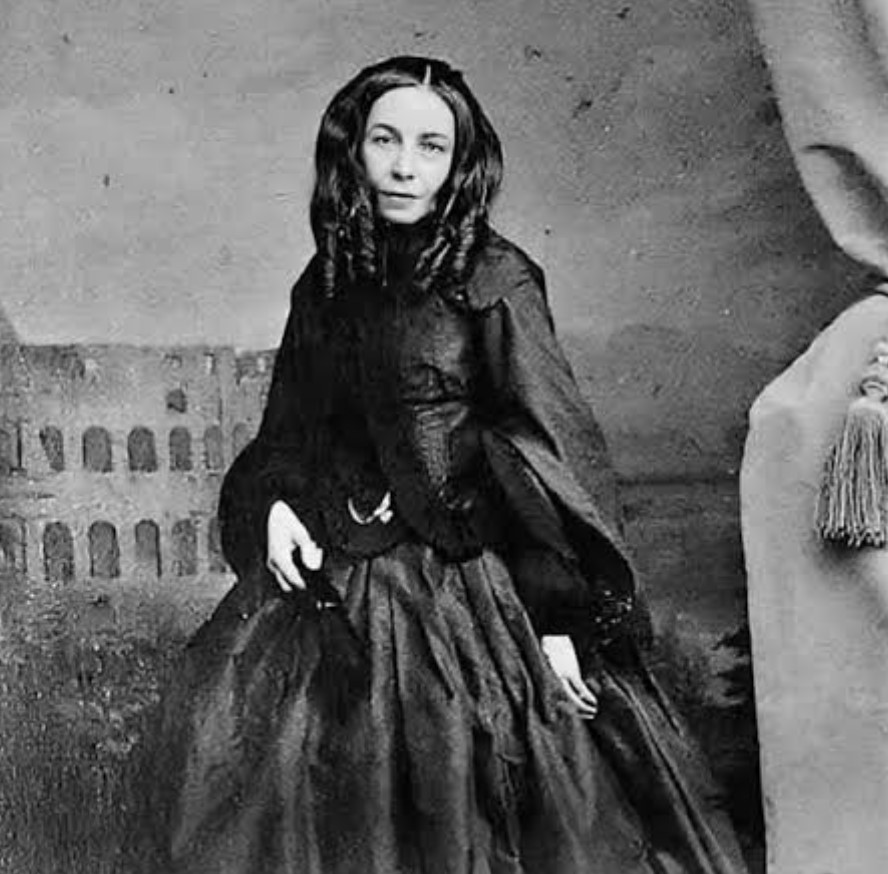
Elizabeth Barrett Browning was one of the most famous writers of the 1800s. Her novel Aurora Leigh and her book of poems, Sonnets From the Portuguese (including How Do I Love Thee?) still resonate. She lived 55 years (1806-1861) and spent much of her life at home as an invalid. Her doctors were baffled as to the diagnosis. Scholars have studied her symptoms and varied illnesses endlessly; there are numerous theories on what she would have been diagnosed with if she lived today. Recently, a new enticing idea has been added to the mix.
First, a little refresher on her life. She was born in Northern England and lived most of her life in or near London. Her family was wealthy. She was the oldest of twelve (!) children. She lived a secluded life at home in her childhood bedroom plagued by chronic illness. Late in life, she and poet/playwright Robert Browning carried on a clandestine courtship (They exchanged over 600 love letters!) and in 1846 snuck out for a secret wedding. Her father disowned her (as he did all her siblings who married) so she and Robert eloped and lived the rest of their lives in Italy. In Italy, she had a much more social life, with many literary friends. They had one son. She died in Florence and was buried there.
She seemed perfectly healthy until she was 14. She and two sisters all became ill, with headaches, malaise, abdominal and back pain. Elizabeth was acutely ill for seven weeks, with paroxysms of muscle spasms in her back and shoulders, along with an unrelenting headache. She was in bed, unable to even sit up. Various doctors blamed a horse-riding incident (which was really nothing more than having to work hard to tighten the horse’s girth). Her sisters improved, but Elizabeth did not. The doctors eventually decided she had a spinal issue and prescribed opium. It initially helped but was less efficacious as time went by. She did, however, take laudanum (opium and alcohol) for the rest of her life. Letters from Elizabeth and others thereafter refer to her spinal deformity, permanent spinal problems, and reference the fact that she was bedridden for two years until she finally somewhat recovered.
For the next 15 years she suffered from what we would call chronic fatigue, with very little stamina or energy. She wrote to a friend what was a typical description of her episodes:
“ I have been exceedingly unwell—confined to my bed nearly a week by a sudden return of bad symptoms and so weak since as scarcely to bear without fainting even the passive fatigue of being carried from this bed to the sofa down stairs…”
Her next period of significant illness was in 1830s, when she was in her 30-40s. She caught a cold that turned into bronchitis, and left her sick with respiratory symptoms that lasted for many years. She intermittently coughed up blood. She would periodically improve enough to leave her bed and even occasionally leave the house. But then, the cold, the damp, or the smoky air of winter would cause her bronchitis to flare up again with fever, tachycardia, spitting blood, headache, insomnia, general exhaustion, and fainting. She was always better in the summer, well enough to walk around the house and sometimes go outside, and worse in the winter. She was notably worse after her favorite brother drowned, taking to her bed for a year.
Then in 1846, after her marriage and move to the warmer climate of Italy, she steadily improved, and wrote of walking outside, up staircases, going out to dinner, and leading a more normal life. Late in life her bronchitic attacks recurred and worsened, and she eventually died what was probably a cardiorespiratory death.
So, what are we to make of these long illnesses? Was she a hypochondriac, a malingerer, an agoraphobic, whose retreat from the bigger world allowed her the freedom to write and avoid the societal restrictions for women of the time? Or was she a brave person with a terrible chronic illness who managed to soldier on and write in spite of severe physical limitations? Scholars are divided.
And are these two illnesses (the spinal issue and the respiratory issue) linked or separate? First, let’s think about them separately. I’m highly suspicious of poliomyelitis in the case of her first illness. There, of course, was no polio vaccine in the 1800s. And most people who got polio were ill but did not become paralyzed. The common symptoms include cold or flu-like symptoms, followed by headache, backache, muscle pains, sometimes muscle cramps and twitches. Sounds a lot like what Elizabeth and her sisters had. Additionally, scoliosis can certainly develop months after polio, due to asymmetrical muscle weakness. So, perhaps Elizabeth had mild polio, with resulting scoliosis, resulting in chronic back pain and some weakness. Or she could have had idiopathic adolescent scoliosis, or vertebral tuberculosis (Paget’s Disease) which could also have led to chronic scoliosis. Some biographers have noted she wore unfashionable clothes that might have disguised a curved back or uneven shoulders, and she usually wore her hair down over her shoulders (also not in fashion) which could have made a physical deformity less obvious. Interestingly, notes about her late in her life describe her as shrunken and deformed.
Now for that second illness, with cough, bronchitis, and coughing up blood. If indeed she had scoliosis, her lungs may have been compressed and her respiratory status would have been compromised, making her a sitting duck for more troublesome lung infections. Tuberculosis was rampant during this era, and doctors of the time often blamed her respiratory problems on TB. Some scholars have mentioned Pertussis (whooping cough, also called the 100-day cough) as a possible cause of her initial prolonged respiratory illness. It was endemic in 1800s London, so this is a good theory. Asthma with chronic bronchitis or resulting bronchiectasis is another strong possibility. Combine these with the polluted damp air that was in London in the Industrial Revolution years, and permanent lung problems could have easily developed.
Add chronic use of laudanum (with both opium and alcohol being addicting), sprinkle a little anxiety, depression, and agoraphobia, and voila, a house-bound invalid! Though much has been made of her lifetime use of laudanum, it was commonly used, over-the-counter, and widely accepted during the Victorian period. Her daily dose was apparently small as she was able to stop during her pregnancies, and when her toddler son Pen inadvertently drank a whole day’s dose, he had no symptoms.
Was her dramatic improvement after marriage to Robert Browning and moving to Italy all due to happiness, getting away from an oppressive family life, or warmer and drier climate in Italy? Who knows?
Recently, another intriguing theory for her lifelong illness has been proposed. A young woman, Ellen Buchanan Weiss, was reading the letters of Elizabeth Browning, and noted that she referred to incapacitating weakness, heart palpitations, intense response to heat and cold, dramatic worsening after illnesses as mild as a cold, and general exhaustion in bouts that lasted from days to months or years. Browning particularly wrote about worsening after eating a generous portion of honey, and a severe bout after getting rained on and soaked. Religious fasting made her terribly worse. As Ellen read these comments, she felt a jolt of recognition. These symptoms sounded like her! She had been diagnosed with a rare genetic condition, Hypokalemic Periodic Paralysis (HKPP).
Rare, affecting only 1/100,000 people, HKPP is a muscle disorder that causes blood levels of potassium to fall because potassium becomes trapped in muscle cells. Then muscles cannot contract normally. Most common symptoms of HKPP include sudden onset of dramatic weakness, often after resting following strenuous exercise, extreme fatigue or tiredness before an attack starts, and severe muscle pain or cramps. A variety of triggers can initiate an attack, including alcohol, hunger, excessive heat or cold, sudden temperature change, illness, sometimes exercise. Symptoms typically have their onset at puberty. Now, flare ups can be treated with IV potassium, but in the 1800s this disease was not known to exist and there would have been no treatment. Ellen says, “it is a stark reminder that we can only see what we are prepared to see. E. Browning… scholars, who know much much more about the poet than I, haven’t deciphered what has jumped out of the page at me because they don’t know HKPP.”
Such a fascinating idea! Could Elizabeth Browning had had the usual illnesses of her era, like polio, pertussis, asthma, bronchitis, but have been totally incapacitated by an underlying rare disease, HKPP? Could her restricted life in bed have been avoided or mitigated if she lived now? Then she never would have had to write:
ENOUGH ! we’re tired, my heart and I.
We sit beside the headstone thus,
And wish that name were carved for us.
The moss reprints more tenderly
The hard types of the mason’s knife,
As heaven’s sweet life renews earth’s life
With which we’re tired, my heart and I.
Interesting! If she had TB, one might guess her siblings and husband would have manifested symptoms. HPP is an intriguing possibility, as is polio.
I always like hearing from you! Thanks for the comment. It is not known if other family members had TB. her mother died suddenly at age 47 while on a trip, but the cause of death is not known. Interestingly, after this, Elizabeth’s father became obsessed with keeping the family together and so he disowned any of his children (including Elizabeth) who got married! Yikes!
Fascinating! She certainly could have had TB explaining the pulmonary and spine problems. Also I agree polio might have caused those residuals as she might have also had a bulbar component leading to chronic pulmonary problems. For the other symptoms a strong contender in the differential is autoimmune small fiber neuropathy. So many diseases prior to the 1970s that we now recognize as autoimmune were written off to hysteria especially in women. Who wouldn’t become a recluse or severely depressed (certainly the death of her brother did not help) when having unpredictable episodes of disabling fatigue, POTS or POTS-like autonomic neuropathy, hyperalgesia and muscle spasms especially when doctors have no idea what the cause is so they label you as crazy/malingering/weak etc. Another great piece of medical sleuthing, Dr Ann Beach!
Love your thoughts! I hadn’t thought of bulbar polio, which could certainly explain chronic respiratory difficulty. Fascinating how the whole field of autoimmune disorders continues to grow, right?