
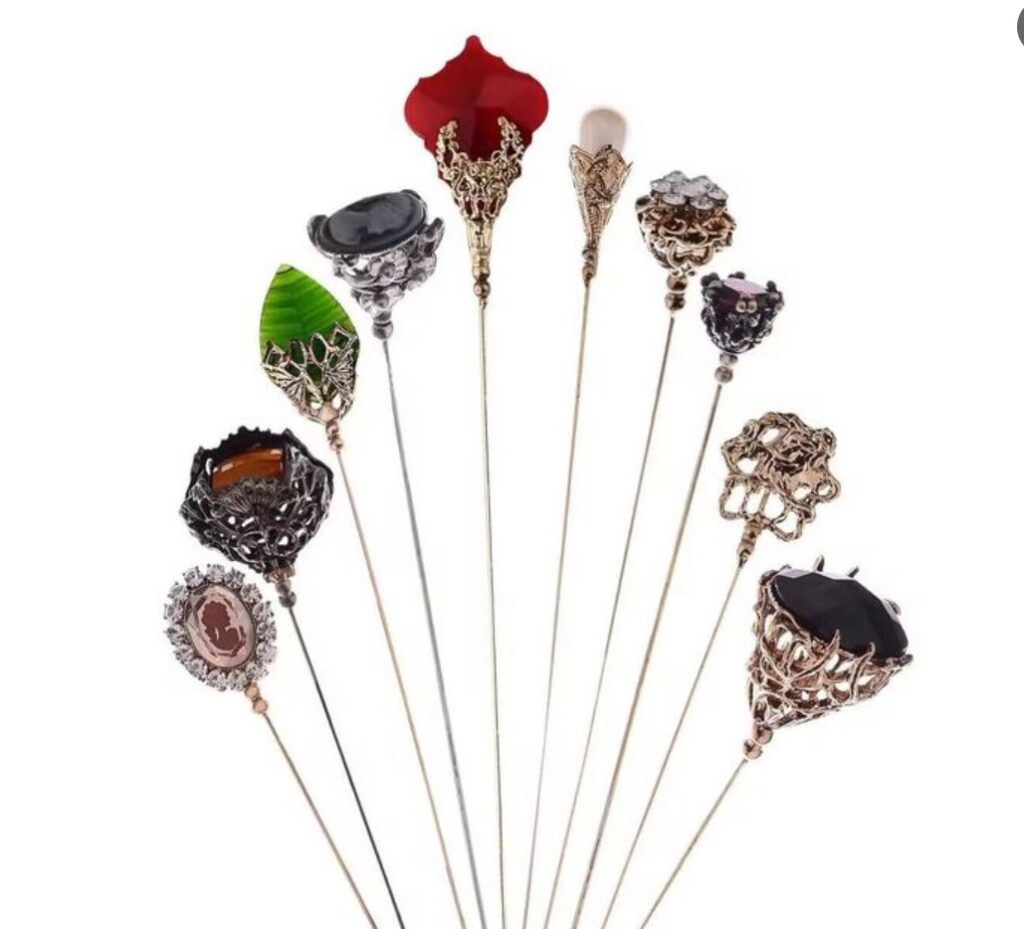
Imagine you’re a liberated woman at the turn of the last century (1890-1915). It’s now allowed for you to travel without an escort and you and some of your friends even have (gasp!) jobs. You are comfortable traveling on public conveyances like buses and trams. You love dressing fashionably and have embraced the enormous picture hats piled atop the elegantly bouffant Gibson Girl hairstyles of the time period. Those huge hats require hatpins to hold them to your head, and the bigger the hats, the longer the hatpins. Some of your pretty hatpins are as long as 14 inches!
This was the situation in the early 1900s. Those fashionable and practical hatpins, as it turned out, could also be dangerous! Imagine jostling along in a crowded bus next a woman with a giant hat with a couple of hatpins sticking out. Ouch! You could easily get stuck! Many people were. The newspapers of the time were full of articles about people with hatpin-related injuries. Given that they were on hats, most of the injuries involved eyes and faces. What in this day and age would just be a scratch or poke could turn deadly in the early 1900s. Remember, in 1900 there was no tetanus vaccine (that wasn’t developed until 1924, and not in widespread use until the 1940s). Also, antibiotics did not exist (sulfa was developed in the 1920s, and penicillin in the 1940s).
The Elmira Star-Gazette reported the death of Howard Miller of Binghamton, NY, in 1907. He died of blood poisoning a few days after being scratched by a woman’s hatpin as he was riding next to her in a trolley. In 1911, The Patriot-News in Pennsylvania wrote about Captain Andrew England, who was scratched on his cheek by a hatpin while riding in a streetcar, developed an infection, and died three weeks later. Hatpins could be dangerous to the wearer as well. The Santa Fe New Mexican reported on a woman who developed tetanus after accidentally stabbing herself with a hatpin in 1905.
Eye injuries were not infrequent. In 1911, The Sacramento Bee reported on a teenager who was accidentally stabbed in the eye by a hatpin while watching a baseball game in Vacaville, CA. That same year, The Fulton County News reported on a Connecticut man whose eye was scratched by a hatpin during a train ride. There was fear he might lose his eye.
There was also a darker side to hatpin use. As social dynamics changed and more women were in the workforce, and often without the accompaniment of male family members, incidents of sexual harassment increased. Women began to report having to defend themselves from “mashers and bedswervers,” who were making unwanted advances. These women used umbrellas, riding whips and particularly hatpins for defense. Again, newspaper reports tell us of the prevailing attitudes. One widespread story, written about in the Carlisle Evening Herald in 1903, told of a visitor to New York City who stabbed a man with her hatpin after he tried to kiss her. He screamed and jumped off the coach. She was quoted as saying, “If New York women will tolerate mashing, Kansas City girls will not.” Initially, women were applauded for their defensive hatpin use. For example, in 1895, the San Francisco Examiner reported on an incident where a stenographer named Jennie Ryan had been stalked by a young attorney. Eventually, she stabbed him with her hatpin. The young man was “arrested for sending insulting letters to Miss Ryan.” As episodes increased, men began to worry and the tone of newspaper articles changed, often blaming the women for being unladylike. In New York City, criminal charges for “felonious assault” were lodged against a woman who stabbed a man with her hatpin after he tried to kiss her.
As defensive use of hatpins mounted, lawmakers decided something had to be done about this terrible menace. Several American cities – including Seattle, New Orleans, Milwaukee, Brooklyn, and Colorado Springs – passed ordinances to restrict the length of women’s hatpins. Similar laws, restricting hatpin length, how far they could protrude from a hat, and a requirement for little caps to be placed on the sharp end of hatpins, were passed. Offenders could be fined up to $500 and sentenced to 6 months in jail. These lawmakers were apparently unconcerned about laws governing the actions of the “mashers and bedswervers.” After such a law was passed in Chicago in 1910, thousands of women signed a petition, asking for liberty to carry hatpins uncurtailed, “…in the name of thousands of ladies who are obliged occasionally to walk home in the night-time…We are not allowed to use revolvers. Hatpins are our only means of defense. Nothing excels a stout hatpin as an effective weapon. Thousands of us, when leaving a tramway-car, hold a hatpin in our hand until we are safe indoors.”
Interestingly, after laws were passed in much of the US, San Francisco continued to stand up for women, refusing to restrict hatpins. In 1904, the San Francisco Call Bulletin went so far as to include a pictorial of how best to utilize hatpins against aggressors in an article entitled “How to Defend Yourself.”
It wasn’t just the United States that was dealing with these issues. The perils of hatpins caught the public’s imagination in Europe and Australia as well. Cities like Zurich, Berlin, and Vienna passed ordinances regulating hatpins and their use. Women refusing to put covers on their hatpin tips were thrown off buses. In Sydney, Australia, sixty women were arrested for “protruding hatpins” and threatened a hunger strike. Self-defense with a dangerous weapon was so incongruous with the notions of ideal femininity that people were torn. Were these women ingenious, or willfully disregarding the safety of others? It became a divisive topic in many countries. The newspaper headlines were inflammatory, citing “the hatpin terror”, “masterminds of civic warfare”, “selfish women harming others.” Men of the time were just not prepared to think of armed women. Never mind wondering why they needed to be armed…..
The popular bawdy British music-hall ballad Never Go Walking Without Your Hatpin had the following chorus:
Never go walking out without your hat pin.
The law won’t let you carry more than that.
For if you go walking out without your hat pin,
You may lose your head as well as lose your hat.
Can you really murder someone with a hatpin? Mystery writers seem to think so. Try reading The Hatpin Killer (Rachel Allen), Death by Pins and Needles (Susie Black), or Last Rights (Barbara Nadel). There are many more. Truth is just as strange as fiction. In 1892, John and Sara Mankin, Australians, were convicted of murdering fifteen infants they had taken in for money. They answered ads from unwed mothers who were seeking adoption of their infants. They promised to care for the infants once the mothers paid a “premium” (known as baby farming). They then killed each baby with a hatpin to the heart. Gruesome! In 1898, Parisian tourist Bartholomew Brandner was killed by a hatpin in a scuffle in a Chicago saloon. Coroner’s details include, “a small puncture which began near the corner of the left eye and expanded far into the interior of the skull.” The details of the scuffle died with him.
Unfortunately, this debate about hatpins came about at the same time as the first efforts of women suffragettes. The public’s concerns about emotional women sticking people with hatpins did no favors for the women trying to forward the vote for women. The “hatpin peril” shored up prejudices regarding the “reckless and irrational” nature of women – doing damage to the idea of universal suffrage.
The end of the hatpin peril was rather anticlimactic. Fashions simply changed with the times. With the advent of WWI, metal and fabric became scarce. Dresses became simpler and hats became smaller. The popular cloche hat required no hatpins. The hatpin furor just faded away.
A new civic danger appeared: the Flapper!
Interested in other stories about dangerous fashions? Look here:
Just curious–where (and how) else were hatpins used? Don’t tetanus spores live on surfaces contaminated with dirt and poop?