
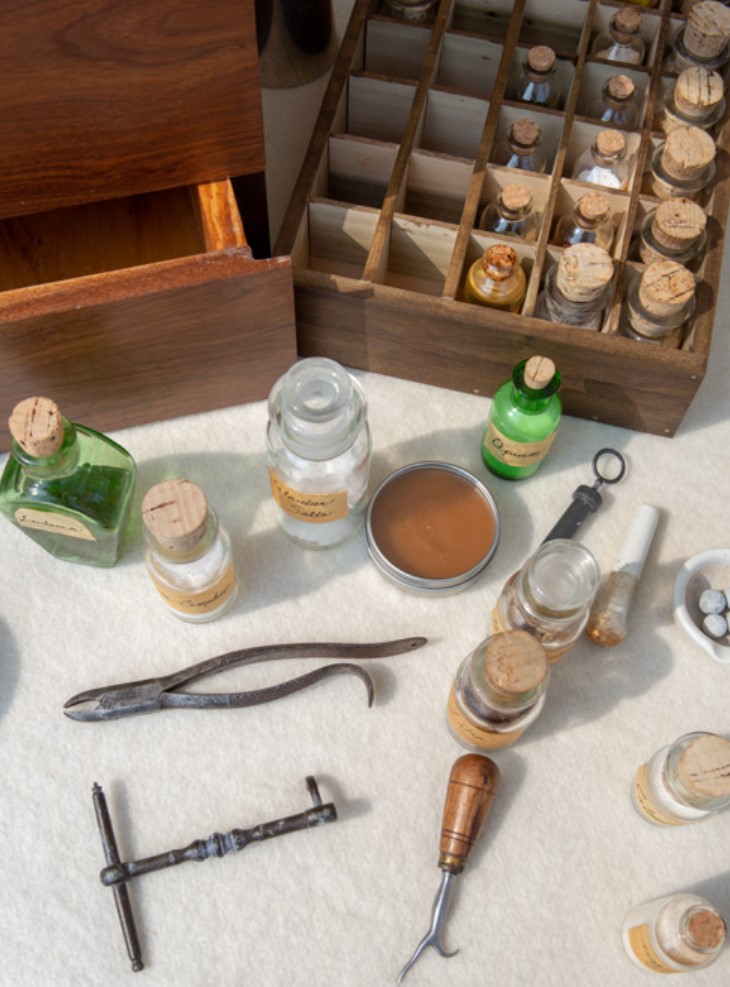
President Thomas Jefferson commissioned the Corps of Discovery (what we now call the Lewis and Clark Expedition) in 1803 to explore the newly acquired Louisiana Purchase and to find a direct water route from the Mississippi River to the Pacific Ocean. It was an audacious journey, and Stephen Ambrose, in his terrific book Undaunted Courage, describes it as “the moon shot of its era.“
This was a pet project of President Thomas Jefferson, one of the most organized and visionary men of American history. The Corps of Discovery men knew very little about the territory they would be exploring, and would not be able to re-supply along the way. Great thought and 16 months of planning went into provisioning and training for the expedition.
I’m particularly interested in the medical aspects of this expedition.
Both Lewis and Clark, along with other frontiersmen and military officers of that time, knew how to set a broken bone, incise and drain an abscess, and remove an imbedded arrow. Both Lewis and Clark could function as the expedition’s doctors; there were no medical licenses at that time (Clark apparently had a better bedside manner). Their isolation on this excursion would be profound, and they would have only themselves (and their team of 33 men) to rely on. So, Meriwether Lewis received an intensive, crash-course of scientific training in Philadelphia in the spring of 1803 from leading members of the American Philosophical Society, studying medicine, botany, and navigation. Thomas Jefferson arranged for him to be taught by Dr Benjamin Rush.
Here’s a refresher on Benjamin Rush. Dr Rush (1745–1813), was the most well-known physician of 18th century America, and was also a signer of the Declaration of Independence. In common with other physicians of his day, Rush, however, had no correct understanding of the causes of diseases. The prevailing philosophy was that diseases were caused by imbalances in the body; the way to remove the “bad” things was with bleeding, vomiting, sweating, and purging. Rush was known as a champion of extreme purging and bleeding (“depletion therapy”).
For three months, Rush taught Lewis practical medicine, frontier illnesses and their treatments, and bleeding techniques. Lewis and Rush created the medical kit for the Corps of Discovery. Containing over 60 medicines, it was a portable pharmacy tailored for survival. Even if you know medicine and pharmacology, you won’t recognize many of these; most of these drugs have fallen out of favor.
Let’s go over some highlights of the list. The contents give us a good idea of what Lewis expected to encounter during the journey.
For ague/intermittent fever (which may have been malaria)- Powdered cinchona bark/Peruvian Bark, and camphor oil to induce sweating. Lewis clearly expected to have to treat frequent fevers; the 15 lbs. of Peruvian bark amounted to 1500 doses!
For pain – Turkish opium, and laudanum (an alcoholic tincture of opium)
For Gastrointestinal maladies– Laxatives and more laxatives. Fifty dozen of Dr. Rush’s Bilious Pills, which the explorers called “thunderclappers”. These large blue pills contained jalap (a Mexican plant that was a strong laxative) and calomel (mercurous chloride, also a powerful laxative). Their meat-rich diet, lack of clean water, and spoiled rations during the expedition gave the men cause to use “thunderclappers” frequently. There was rhubarb (Not the culinary plant you eat, but a botanical used for purging and as a treatment for diarrhea), ipecac to induce vomiting and sweating, essence of peppermint for indigestion, and medicinal wine.
For VD- Lewis expected venereal diseases; trappers and traders who returned from the West told of rampant venereal disease among the Natives. They packed Calomel (Widely accepted as a treatment for syphilis, it contained mercurous chloride, which eventually led to mercury poisoning), and Mercury ointment, to sooth lesions from gonorrhea.
For wounds, abrasions, bites, boils- They expected flea bites, mosquito bites, and painful boils, as well as abrasions and foot injuries from long hours hiking over rough terrain. The kit included various soothing ointments such as Unguent basilicon (hog lard, white resin, yellow wax), and something you may have heard of, Calamine ointment.
For Irritated eyes- Zinc sulfate and Sugar of Lead eye wash
Out of this list, there were at least two drugs which were actually effective. Peruvian bark from the cinchona tree was found to contain quinine, which proved to be effective against malaria. Malaria was endemic in the Ohio and lower Mississippi and Missouri River valleys at that time, so the Peruvian bark in the medical kit probably did help some of the fevers men had on the expedition. Today, we know the processed forms of opium and laudanum: morphine and codeine.
In addition to these medicines, the kit included lancets for bloodletting, penis syringes for VD medication, clyster pipes (for enemas), surgical and dental instruments, bandages, an amputation saw, a tourniquet.
So, did Lewis and Clark guess correctly? What medical conditions did they encounter during their two-year expedition? The diaries of Lewis and Clark contain a litany of injuries (falling out of boats, pinned against rocks, falling off cliffs, bear attacks, burns, cuts, broken arms), rattlesnake bites, fevers, food poisoning, diarrhea, and overexertion. Colds, sore throats, red eyes, and stomachache were common. Constant exposure to the elements and intermittent starvation weakened the men. The medical kit was in constant use. Here are a few standout examples of their medical experiences.
During the winter of 1804-5, at Fort Mandan in present day North Dakota, Sergeant Nathaniel Pryor suffered a dislocation of the right shoulder while taking down the mast of the keelboat. Four attempts were required to reduce the shoulder. Ouch! I hope he got plenty of laudanum! In January 1805, the temperature fell to 40 below zero. A Native Mandan boy was brought to the captains with frostbite involving his feet. Later Clark wrote that he “sawed off” the boy’s toes.
In mid-June 1805, the invaluable interpreter, guide and native liaison Sacagawea became ill with abdominal pain, vomiting, and fever. Clark bled her, gave her cathartics, and applied a poultice of powdered Peruvian bark to her lower abdomen. She worsened with a rapid and irregular pulse and twitching of her muscles. Lewis gave her water from a nearby spring, as well as bark and laudanum. Modern analysis of water from a spring in that area shows significant amounts of sodium, potassium, and calcium. Thus, the spring water may well have corrected her dehydration and electrolyte abnormality and contributed to her eventual complete recovery.
In what is now Helena Montana, in July 1805, Lewis wrote: “…the prickly pear…. now become so abundant in the open uplands that it is impossible to avoid them and their thorns are so keen and stif that they pearce a double thickness of dressed deers skin with ease. Cap C. informed me that he extracted 17 of these bryers from his feet this evening after he encamped by the light of the fire.” Lewis also wrote, “our trio of pests are the Musquetoes eye knats and prickley pears, equal to any three curses that ever poor Egypt laiboured under”.
The miserable winter of 1805-6 spent at Fort Clatsop (present day Oregon) was cold and wet. As might have been expected from the close quarters, the monotonous diet, and the climate, respiratory infections were common. A few of the men became quite ill, possibly with pneumonia.
On their return journey in 1806, the unthinkable happened. Lewis was elk hunting with Private Pierre Cruzatte (who was blind in one eye and had poor vision in the other). Cruzatte mistook Lewis, who was dressed in leather, for an elk. Lewis wrote: “ I was in the act of firing on the Elk a second time when a ball struck my left thye about an inch below my hip joint, missing the bone it passed through the left thye and cut the thickness of the bullet across the hinder part of the right thye… I dressed my wounds myself… the pain I experienced excited a high fever and I had a very uncomfortable night.” (He’s a master of understatement, right?) They made it back to camp, where Clark cleaned and redressed the wounds. Lewis spent weeks lying face-down in a stretcher and by the end of the journey, he had completely recovered.
Astonishingly, only one man died during the expedition. Early in the expedition, Sgt. Charles Floyd developed acute abdominal pain. In spite of all treatments, he died after a 3-week illness and was buried near present day Sioux City, Iowa. Many medical historians believe that Floyd most likely died of peritonitis due to a perforated appendix, something untreatable at that time.
My assessment? Lewis and Clark’s medical kit had most of the standard 19th-century remedies they anticipated needing, and they used most of its contents. Despite the flaws (heavy reliance on toxic mercury and extreme purging methods) and lack of antibiotics and sterile technique, the kit enabled Lewis and Clark to be amazingly successful. I also don’t discount the role sheer good luck may have had in the difference between recovery and death.
Ann,
I agree that they were amazingly lucky. At least they had calamine and cinchona bark. They were also physically fit and mentally tough. Walking 2000 miles with the footwear and clothing they had was a feat (no pun intended).
Very interesting and well researched. The story of the hunting incident in which Lewis was mistaken for an elk was priceless!