
History and classic literature are full of stories of people dying of broken hearts. It is one of the most romantic ideas in storytelling; someone’s love is so powerful their lover dies without it.
For example, Catherine Earnshaw (Wuthering Heights by Emily Bronte) wastes away during her pregnancy after Heathcliff departs and then re-enters her life. She loses the will to live. Dramatically, King Lear (King Lear by William Shakespeare) loses his mind after the death of his beloved daughter Cordelia. He carries her lifeless body on stage, rages and mourns and then dies, unwilling to live without her.
Fact may be stranger than fiction, and there are numerous examples throughout history. The beautiful Princess Ka’iulani of Hawaii was the heir apparent to the Hawaiian monarchy. However, in 1893 the monarchy was overthrown (by Americans). She died shortly thereafter of a febrile illness, but her contemporaries were sure the loss of her nation’s independence broke her heart, leading to her death. President Andrew Jackson’s presidential campaign (1828) was notable for terrible smear tactics. His wife, Rachel, had been married previously, and divorced from her husband. Relentless accusations of bigamy stemming from a technicality in that earlier divorce were deeply humiliating for her. She had a heart attack and died just weeks before Jackson’s inauguration. Jackson was always convinced the political cruelty had broken her heart.
There are plenty of examples in our own lifetimes. June Carter Cash died in May 2003 after complicated heart valve surgery. Johhny Cash was devastated and died less than four months later. He did have complications from diabetes, but his family always said he died of a broken heart without her. Only ten years ago, Carrie Fisher, (Princess Leia in Star Wars and many other roles) died of a sudden cardiac arrest several days after a medical emergency during a transatlantic flight. Only one day later, her mother, the wonderful actress Debbie Reynolds (Singing’ in the Rain, The Unsinkable Molly Brown, and many others) died of a stroke. In a later interview, her son Todd said his mother had joined his sister in death because Reynolds “didn’t want to leave Carrie and did not want her to be alone.”
So, looking across the centuries, perhaps there is a pattern in these sudden grief-related deaths. None of these deaths were just from sadness alone. Illness, infection, old age, and pre-existing conditions were always there, acting as an accelerant. So, can you really die of a broken heart? What does modern science say?
In the 1970s, several medical articles were published about the increased rate of death after stressful events, including a seven-fold increase in the risk of dying within one year after the death of a close relative. Studies showed that acute grief, mourning on an anniversary, personal danger, a national disaster, even a very happy ending could create enough stress to increase the risk of sudden death. Physical stresses such as surgery, or major trauma were factors as well. It was felt that high levels of catecholamines (chemicals that trigger our “fight or flight” response, like adrenaline) could stress the heart muscle.
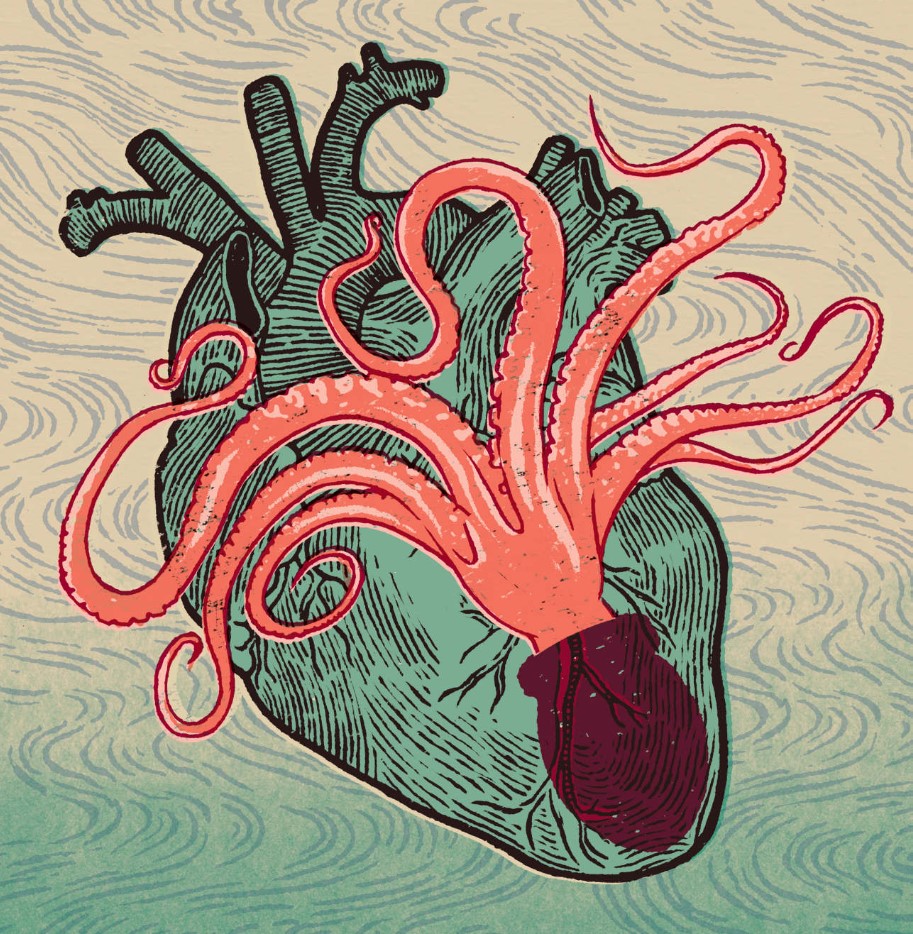
In 1990, Dr Hikaru Sato in Japan noticed a distinct pattern in patients experiencing sudden chest pain. He and his team would perform emergency cardiac catheterizations, expecting to find blocked coronary arteries (the classic finding in heart attacks). Instead, they sometimes found clear arteries, and an unusual shape to the left ventricle (the main pumping chamber of the heart). He noticed the affected left ventricle didn’t contract normally. Instead, it ballooned in an abnormal way, resembling the round jar Japanese used for catching octopuses (called a takotsubo). Further interviews with these patients revealed a direct link to a preceding stressful event, like the death of a loved one. Now usually called broken-heart syndrome or stress-induced cardiomyopathy (cardio= heart, myo= muscle, pathy= abnormal), takotsubo cardiomyopathy happens when surging stress hormones essentially “stun” the heart, triggering changes in the heart muscle that keep it from contracting normally. To the person it is happening to, it feels just like a heart attack (chest pain, sweating, pressure in the chest), and an EKG can look just like a true heart attack. The difference is, the coronary arteries are not blocked, as in a typical heart attack, and the tell-tale ballooning of the left ventricle can be seen during cardiac catheterization.
There is a known association of stroke with takotsubo cardiomyopathy; stroke can be both a cause and a consequence of takotsubo. A quite robust association between “broken heart” and “broken brain” is undeniable but it is not clear which is the chicken and which is the egg. Research is ongoing.
Interestingly, 85% of reported cases are in women age 58-75. It’s not entirely clear why this is, but it is suspected that the drop in estrogen in post-menopausal women increases the sensitivity of the heart muscle to those stress catecholamines.
Thankfully, most people recover with no permanent heart damage. However, in the short term, the abnormally functioning left ventricle can struggle, leading to arrhythmias, low blood pressure, fluid accumulation, and leg swelling. Untreated, these can be life-threatening. Death rate is around 5%. With appropriate treatment, 95% of people with broken-heart syndrome recover fully within two months.
There have been some rare cases of clusters of broken-heart syndrome in families, but large-scale genomic studies have so far failed to show any clear genetic predisposition for this syndrome.
There’s no known way to prevent broken-heart syndrome, and current researchers recommend standard lifestyle changes, stress-reduction classes, and general exercise and healthy eating. I suppose it is impossible to recommend avoiding being jilted, divorced, or being involved in an earthquake or car wreck! New York University School of Medicine has a takotsubo registry, and they are following volunteers who have had broken-heart syndrome, hoping to learn more in the future.
For now, I’ll be singing Jimmy Ruffin’s, What Becomes of the Broken Hearted?, or Toni Braxton’s Unbreak My Heart, or Al Green’s How Can you Mend a Broken Heart.
I liked this a lot. Can a person’s hair suddenly go completely white as was described in Victor Hugo’s Les Miserables? Jean Valjean, the character, I believe.
Oooh! Great question! Perhaps a future blog……