
In 1818, vast new tracts of land opened for settlement in the central part of Indiana. The brand-new state was a rapidly growing part of the frontier, and homesteaders were clearing timber, building cabins, and creating farms. But there was a problem. Settlers were dying in Pigeon Creek, Indiana, and it wasn’t clear why. And it wasn’t just Pigeon Creek. In Ohio, Kentucky, Illinois, Tennessee, and Indiana, especially along the Ohio River and its tributaries, people were dying from “the trembles”. It seemed to happen in the summer, after dry spells. It wasn’t like any illness settlers who came from the East Coast had ever seen or heard of. Was it from witches? Poisonous vapors? A curse? People abandoned parts of the Wabash River Valley in Indiana and Illinois, believing the area to be cursed. This strange illness was one of the most common causes of death in the early 1800s. Thousands of settlers died. Yet we have never heard of it!
Dr Thomas Barbee of Bourbon County, Kentucky, first described what came to be known as milk sickness in 1809, as the illness “under which man turns sick and his domestic animals tremble.” Cattle and people with milk sickness developed trembling in legs and face. As the illness quickly progressed, abdominal pain, extreme thirst and vomiting developed. Weakness and difficulty walking progressed to stupor, coma, and death. It had a shockingly high mortality rate, sometimes as high as 50%. It was an illness as feared as cholera and yellow fever, and the cause was not known at the time. The usual treatments, bloodletting and purgatives, were ineffective. People knew there was a link with milk from livestock, but why milk sometimes made people ill and other times didn’t was not understood.
And in Pigeon Creek, 34-year-old Nancy Hanks Lincoln died quickly from milk sickness. Her 9-year-old son, Abraham, always remembered helping carve the wooden pegs for her coffin. Several neighbors also died of milk sickness that year.
This scourge was so ruinous that in 1830 the Kentucky General Assembly offered a $2000 reward ($70,000 today) to anyone who discovered the cause of the illness. With time, farmers learned that clearing land and only grazing cattle on tended fields controlled the problem. But they still did not know why. And in times of drought, or when pastures were scarce, farmers let their livestock graze freely in the woods; then milk sickness would crop up again.
Enter Dr Ann Pierce Hobbs Bixby. From Philadelphia, she settled in Illinois in 1828. Alarmed by the poor health of her new community, she returned to Philadelphia to take courses in nursing, midwifery, and dental extraction, all the medical courses offered to women of the day. She returned to Illinois and became the local frontier doctor. (She may possibly have been the first female doctor in Illinois). Then, milk sickness killed her mother and sister-in-law. Her father became ill as well, and returned to Philadelphia for treatment. Anna began to research milk sickness with a vengeance, feeling it was her responsibility as the local doctor to solve the mystery.
Her first observation was that it was related to drinking milk or eating butter. Secondly, she was intrigued to learn it was seasonal, and seemed to end after the first frost. She also noted that milk cows seemed immune, but sometimes calves or steers died from the disease. She wrote in her diary, “I am convinced now that the poison which kills the calves and people saves the cows by being discharged through the milk glands. So I am writing a few letters this morning and telling everyone I can to abstain wholly from milk and butter from June until after the killing frosts.” She found it interesting that this illness rarely affected sheep or goats; mainly cows were sickened. She reasoned it must be from a toxic plant the cattle were eating. “Sheep and goats are careful in selecting their foods, and horses are grass-eaters, while cattle are herbivorous and not careful in their selection. These things prove to us that it is not a grass, but an herb that is spreading sorrow and death among us.” But which one?
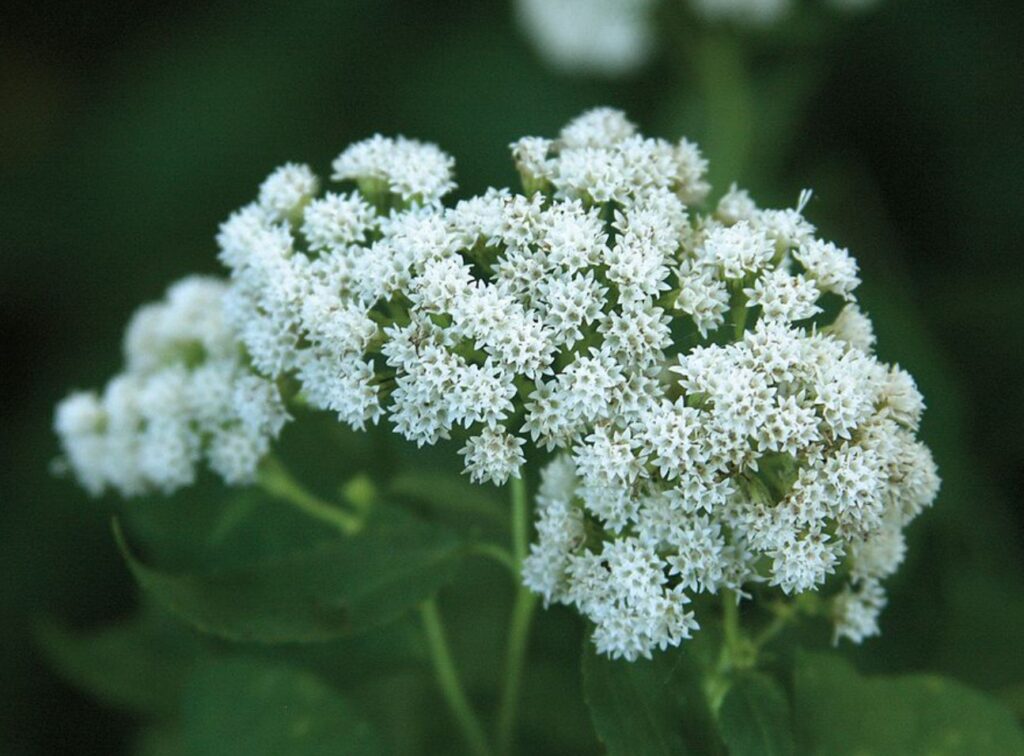
In 1834, Anna was tracking cattle through the woods to watch what plants they were eating. She met an elderly Shawnee Indian medicine woman. Due to the Indian Relocation Act of 1830, the Shawnee were being forced to migrate to Kansas, and this woman was hiding to evade relocation. Anna took her home for food and rest. As Anna talked about milk sickness and her search for a poisonous plant, the Shawnee woman knew exactly what she was looking for. She took her to the forest and showed her a small plant with fuzzy white flowers, declaring this was what poisoned cows and their milk.
It was white snakeroot (Ageratina altissima), a common perennial herb native to the eastern half of the US. More common in forests and uncultivated land, it found its way into the cows’ diet when they were foraging in the woods and edges of fields. Anna experimented to prove this plant was the culprit. She fed white snakeroot to animals, and watched the development of the tell-tale symptoms. She began to spread the word. She had the men in her community canvass forests and fields, destroying the plant. She wrote letters to nearby physicians, telling them about her discovery, and inviting them to her garden to see the plant so they could teach others how to identify it. Within a few years, white snakeroot was almost eradicated in southern Illinois, and the prevalence of milk sickness plummeted.
Not so fast. We don’t have an immediate happy ending here. Even as late as 30 years later, people were still dying of milk sickness in other parts of Illinois and Indiana. And as late as 1855, doctors were hypothesizing arsenic was the cause of milk sickness. Textbooks of the time, which rarely mentioned frontier medicine, had no notes about milk sickness. And a frontier woman doctor wasn’t likely to be widely believed. Unfortunately, new medical knowledge sometimes takes a long time to disseminate.
By 1900, agricultural practices were more industrialized, and cows were less likely to forage in forests, and more likely to be fenced in cultivated pastures, getting hay, and controlled feed. Milk sickness finally became less common.
It wasn’t until 1927 that the US Department of Agriculture did a chemical analysis of the toxic substance in white snakeroot. There are several toxic compounds in snakeroot, including an alkaloid that is toxic to the liver. The main toxin appears to be tremetol. A complex ketone, it binds with fat and thus is concentrated in cow’s milk. Tremetol causes extensive muscle necrosis, affecting all muscles, but especially the heart, causing degeneration and resulting in cardiac myopathy, irregular heartbeat, and heart failure.
The last reported case of milk sickness was in 1963 in St. Louis. Two infants were dangerously ill with unexplained acidosis. They were hospitalized, treated, and survived. It wasn’t until after they recovered that an older doctor heard about them, remembered a case of milk sickness from many years earlier, and noted the similarities. As it turned out, they had been fed milk from a small local farm. So, the cause of their illness was finally diagnosed.
Modern dairy practices being what they are, our milk is from pooled milk from many cows (which would dilute any random snakeroot), from cows in pastures with weed management, so we don’t have to worry. But as small-batch rural dairy farming becomes more popular, this illness could crop up again. And it surely would be hard to recognize since there hasn’t been a case in over 60 years….
But still, drink your milk! Enjoy that butter! And drink a milk toast (!) to Dr Anna and the Shawnee medicine woman!
I have encountered snakeroot during my hiking. It’s a pretty but dangerous plant, somewhat like pokeweed.